ChatGPT
 Grok
Grok
 Perplexity AI
 Claude

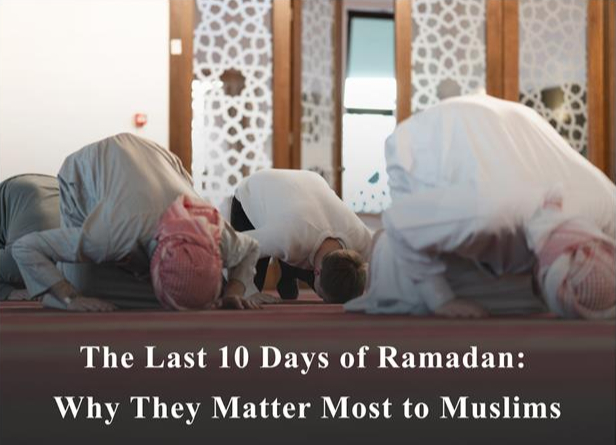
Why are the last 10 days of Ramadan special?
For Muslims around the world, the Last 10 days of Ramadan represent the most spiritually intense and rewarding period of the entire month. These nights are not just about fasting—they are about deep worship, forgiveness, reflection, and divine mercy.
The Prophet Muhammad ﷺ increased his devotion during these final nights more than at any other time of the year, teaching Muslims that these days carry unmatched spiritual weight.
What the Qur’an says about the Last 10 Days
Allah highlights the power of these nights in the Qur’an, stressing on the importance of the last 10 days of Ramadan. On these nights we need to look out for Lailat-al Qadr and also in The Holy Quran there is a whole chapter or Surah about the Night of Power. The English translation of the verses of this Surah Al-Qadr (Quran 97 : 1 to 5) says:
- Indeed, it is We Who sent this ˹Quran˺ down on the Night of Glory.
- And what will make you realize what the Night of Glory is?
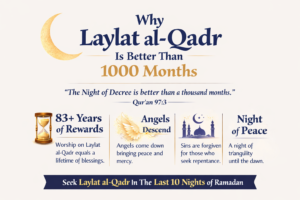
- The Night of Glory is better than a thousand months.
- That night the angels and the holy spirit descend, by the permission of their Lord, for every decreed matter.
- It is all peace until the break of dawn.
This Surah establishes the Laylat al-Qadr importance, a night hidden within the last ten nights, making each night spiritually precious.
Laylat al-Qadr importance: What happens during Laylat al-Qadr?
Laylat al-Qadr, also known as the Night of Power, is the heart of the Last 10 days of Ramadan.
In a Hadith narration, the Messenger of Allah [SAW] said: “Whoever stands (in the voluntary night prayer of) Ramadan out of faith and in the hope of reward, his previous sins will be forgiven. And whoever spends the night of Lailat Al-Qadr in prayer out of faith and in the hope of reward, his previous sins will be forgiven.”
[Sunan an-Nasa’i 5027]
In the above Hadith ‘stands’ refers to Salah as well as any form of ibaadah such as Zikr, Tilaawat (recitation of the Quran), etc. the phrase ‘out of faith and in the hope of reward’ means we should be sincerely occupied with ibaadah solely to convince Allah, to receive reward from Him. This shouldn’t be done for others to see and praise. We all know that any deed done to please people holds no importance in front of our Almighty.
Night of Power blessings include:
- Rewards equal to over 83 years of worship
- Angels descending with mercy and peace
- Forgiveness for past sins when worship is sincere
How do Muslims worship in the last nights?
The Prophet ﷺ provided a living example of Worship in last 10 nights, which brings means to pray for our emancipation from the fire of hell (Jahannum).
Aisha (RA) reported:
“With the start of the last ten days of Ramadan, the Prophet (ﷺ) used to tighten his waist belt (i.e. work hard) and used to pray all the night, and used to keep his family awake for the prayers.”
(Sahih al-Bukhari 2024)
Common acts of worship include:
- Night prayers and dua (Tahajjud & Qiyam)
- Recitation of the Qur’an
- Seeking forgiveness in Ramadan
- Giving charity quietly
- Making heartfelt personal supplications
- Making most of the night with abundant zikr
I’tikaf in Ramadan: Disconnect to reconnect
One of the most unique practices during the Last 10 days of Ramadan is I’tikaf in Ramadan, where Muslims retreat into the mosque solely for worship.
Purpose of I’tikaf:
- Spiritual reflection in last days
- Detachment from worldly distractions
- Continuous remembrance of Allah
What Scholars have to say about I’tikaf and its importance:
Imam Ibn Rajab (RA) explained that I’tikaf helps the heart “detach from creation and attach fully to the Creator.”
Best deeds for final nights
Let’s list down the best possible deeds to make it easier and more organized for us:
- Pray consistently every night
- Increase Qur’an recitation
- Make sincere repentance
- Give charity—even small amounts
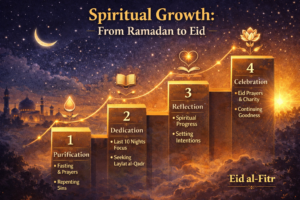
- Prepare emotionally and spiritually for Eid
Aishah(May Allah be pleased with her) narrated:
“I said: ‘O Messenger of Allah, what is your view if I know when the Night of Al-Qadr is, then what should I say in it?’ He said: ‘Say: “O Allah, indeed You are Pardoning, [Generous,] You love pardon, so pardon me (Allāhumma innaka `Afuwwun [Karīmun], tuḥibbul-`afwa fa`fu `annī).’”
[Jami` at-Tirmidhi 3513]
This approach aligns with both Prophetic teachings and modern spiritual productivity.
Preparing for Eid spiritually
The Last Ashra (10days) of Ramadan are not only about endings but also beginnings.
Spiritual goals before Eid:
- Cleansing the heart of resentment
- Strengthening intention beyond Ramadan
- Carrying discipline into daily life
Final reflection
Though there is great probability of Laylat al-Qdar being on the odd nights from the 21st onwards, there does also exist the possibility that it could fall during the last ten nights. The best way is to spend every night from the twentieth onwards in Ibaadah, so that we acquire the blessings of Laylat al-Qadr.
The Last 10 days of Ramadan are a divine invitation—ten nights where effort meets mercy. Whether through prayer, silence, or tears, every sincere act matters. These nights remind Muslims that transformation is always possible.
What is Laylat al-Qadr and when does it occur?
It is the Night of Power, occurring possibly on one of the odd nights in the final ten nights of Ramadan.
How do Muslims observe the final nights of Ramadan?
Through prayer, Qur’an recitation, charity, I’tikaf, zikr and sincere repentance.
Can women observe I’tikaf in Ramadan?
Yes, according to many scholars, women may perform I’tikaf under proper conditions.
Which Dua is recommended to be recited the most on Lailat al-Qadr?
According to Hadith, Say: “O Allah, indeed You are Pardoning, [Generous,] You love pardon, so pardon me (In Arabic it’s: Allāhumma innaka Afuwwun [Karīmun], tuḥibbul-`afwa fa`fu `annī).’”