ChatGPT
 Grok
Grok
 Perplexity AI
 Claude

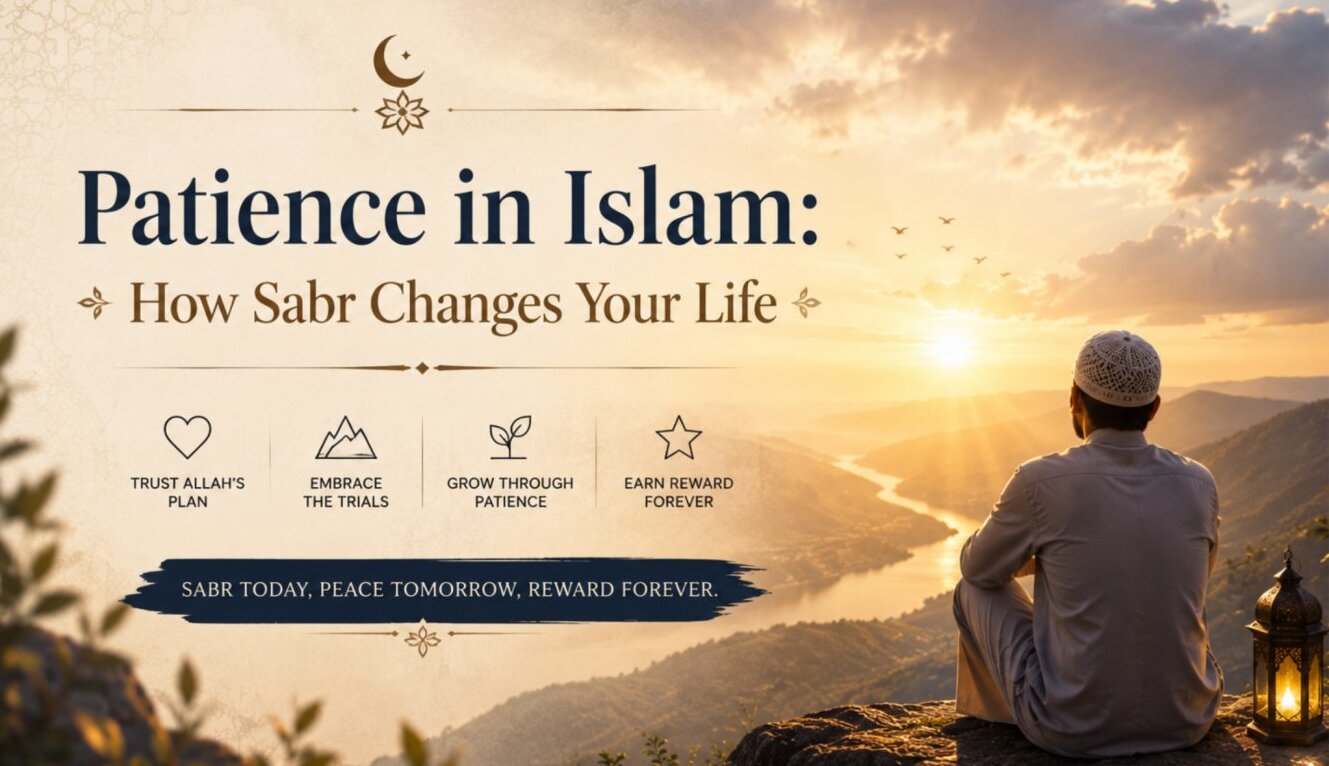
Patience in Islam, known as Sabr, is not merely waiting; it’s an active self-control, perseverance, and trusting Allah during hardships. A believer must always be thankful when his life is easy and must be patient when he faces difficulties. If we are patient and turn to Allah in our difficulties, He helps us.
We should keep our faith in Allah intact at all times. When practiced sincerely, Sabr in Islam becomes a source of inner peace, strength, and hope. Trials in Islam are not signs of Allah’s anger, but opportunities for spiritual growth and purification. The Quran promises that those who practice patience will receive immeasurable rewards in the Hereafter.
What Does Patience in Islam Mean?
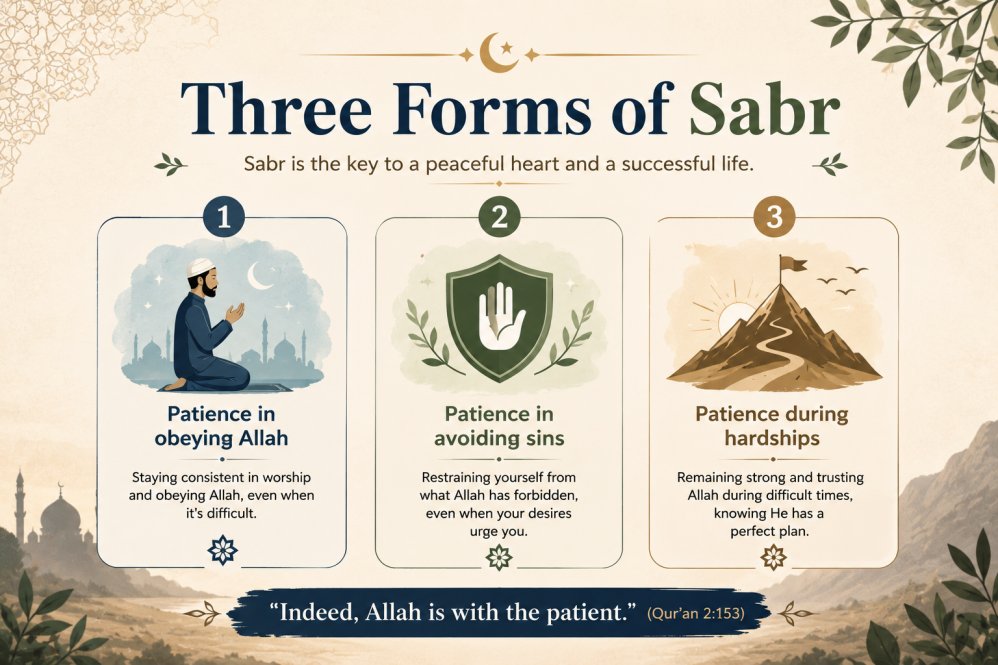
The Arabic word Sabr means steadfastness, perseverance, self-restraint, and endurance. It goes beyond simply waiting. It means remaining firm upon faith during hardships, controlling anger, resisting sinful actions, and continuing to obey Allah even when life becomes difficult.
The Qur’an repeatedly reminds believers that patience is among the qualities loved by Allah.
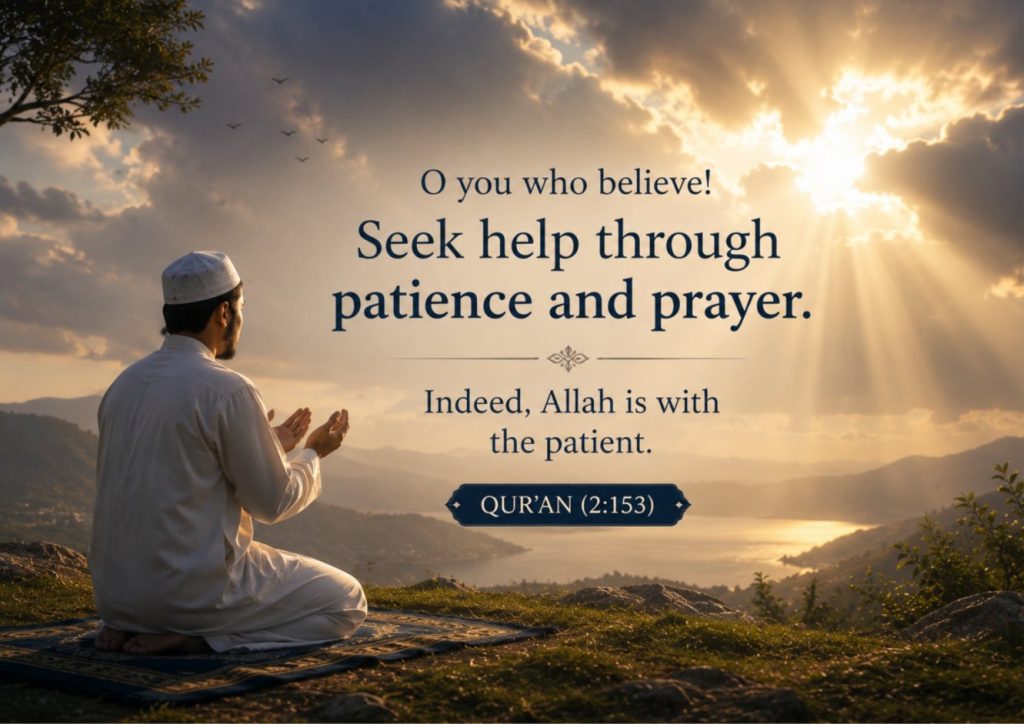
“O believers! Seek comfort in patience and prayer. Allah is truly with those who are patient.”
(Qur’an 2:153)
This beautiful verse from the Quran on patience reminds us that believers are never alone. Allah’s support accompanies those who remain patient and continue to turn to Him.
Scholarly Insights
Hashim Abu Yusuf while presenting his view on sabr and patience in Islam says, Sabr is not patience. Patience is one form or one part of Sabr and not the whole manifestation.
Sabr is self control. Sabr is to be able to control or confine or trap your ego or your desire for what it wants. And this may come in many forms. One of them is that if something bad happens to you rather than breaking down or tearing hair out you have to control your reaction and measure your response, that’s one form of selfcontrol.
Another form of Sabr is to be consistent in your act of worship. Example is that you read a complete Quran in Ramdan. What’s stopping you from reading the Quran every month? Its lack of sabr otherwise called discipline, persistence or whatever you want. Ultimately you lack the discipline to turn up everyday and do something repeatedly. The lack of persistence of discipline is a form of breach of sabr.
When everything you have tried has failed, don’t lose hope in Allah. That’s the gravest of sins. Nobody loses hope in Allah except those who have lost.
We have been asking, praying and pleading but nothing happened.
At that time remember:
- You have not lost more hope than Zackaraiah (AS) after 100 years of trying to have a child.
- You have not lost more hope than Ayyub (AS) after decades of chronic illness.
- You have not lost more hope than Ibrahim (AS), whose father threw him into fire.
- You have not lost more hope than Muhammad ﷺ, who buried his sons, his uncle, his mother with his hands.
Why Does Allah Test Believers?
We usually misunderstand that hardship means Allah is displeased. In reality, Trials in Islam are often a means of purification, spiritual growth, and elevation.
Allah says:
“We will certainly test you with a touch of fear and famine and loss of property, life, and crops. Give good news to those who patiently endure “
(Qur’an 2:155)
The following verse continues:
“They are the ones who will receive Allah’s blessings and mercy. And it is they who are ˹rightly˺ guided. “
(Qur’an 2:157)
These verses beautifully explain that those who endure with patience have great reward from Allah and they are the ones who are rightly guided by Allah. Isn’t that a beautiful blessing when Allah has chosen you to be among the rightly guided?
The Example of the Prophet ﷺ
The life of Prophet Muhammad ﷺ is one of the greatest examples of patience. He experienced rejection, persecution, loss of family members, poverty, and countless difficulties, yet he remained compassionate and steadfast.
He ﷺ said:
“Strange are the ways of a believer for there is good in every affair of his and this is not the case with anyone else except in the case of a believer for if he has an occasion to feel delight, he thanks (God), thus there is a good for him in it, and if he gets into trouble and shows resignation (and endures it patiently), there is a good for him in it.”
(Sahih Muslim 2999)
This hadith teaches that every situation becomes beneficial when approached with faith, gratitude, and patience.
Another beautiful narration states:
“The Prophet (ﷺ) said, “No fatigue, nor disease, nor sorrow, nor sadness, nor hurt, nor distress befalls a Muslim, even if it were the prick he receives from a thorn, but that Allah expiates some of his sins for that.”
(Sahih al-Bukhari 5641)
The Reward of sabr is therefore not limited to this world but extends into the Hereafter.
Benefits of Patience in Everyday Life
The Benefits of patience extend beyond spiritual rewards. They positively influence every area of life.
1. Strengthens Faith
Every difficult moment reminds believers to rely entirely on Allah during hardships.
2. Brings Emotional Peace
Instead of reacting impulsively, patience allows believers to respond with wisdom and calmness.
3. Improves Relationships
Patience helps people forgive mistakes, avoid unnecessary conflicts, and communicate with kindness.
4. Leads to Better Decisions
Emotional decisions often result in regret. Patience creates space for thoughtful choices guided by faith.
5. Earns Allah’s Love
The honour given to those who remain steadfast is something extraspecial which is even mentioned in the Quran in (3:146) and in many places.
How to Develop Sabr in Islam
Patience is a quality that grows with consistent effort.
1. Turn to Allah Through Prayer
Whenever difficulties arise, seek comfort in Salah and sincere supplication. We may observe voluntary prayers or fasts.
2. Remember Allah’s Promise
Reflect regularly on verses from the Quran on patience that remind believers of Allah’s mercy and reward.
3. Control Immediate Reactions
The Prophet ﷺ taught believers to manage anger and avoid speaking hurtful words during emotional moments. Never question Allah’s trials in an emotionally broken state, for trials in Islam escalate your position in front of Allah.
4. Focus on the Bigger Picture
Every hardship has wisdom, even when we cannot immediately understand it, remember Allah has a huge reward for it.
5. Keep Good Company
Being around righteous people strengthens faith and encourages perseverance during difficult times.
Mufti Ismail Menk says, bear with patience on what has befallen you, think of the positives while you are in the negative. While Allah took one thing away from you, think of thousands of things Allah has actually given you. Even if something is not replaceable Allah will replace it with something better in the hereafter.
When we see the reward of the Sabr, we won’t be let down.
Key Takeaways
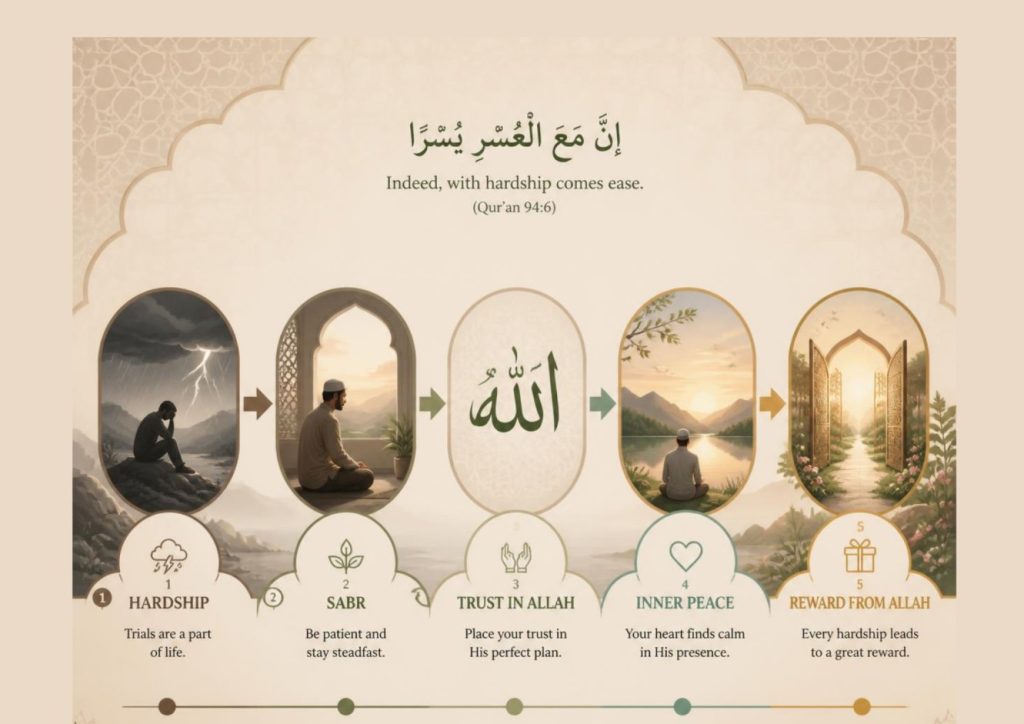
- Sabr in Islam means steadfastness, self-control, and trust in Allah—not passive waiting.
- Trials are opportunities for purification, spiritual growth, and earning Allah’s mercy.
- Every hardship endured with faith carries immense reward in this life and the Hereafter.
- Patience strengthens faith, improves character, and brings inner peace.
- Sabr can be developed through prayer, remembrance of Allah, self-discipline, and righteous companionship.
Conclusion
Life will always include moments of uncertainty, loss, and waiting. However, Islam teaches that these moments are never meaningless. Every difficulty becomes a path toward spiritual growth when faced with faith and perseverance.
By practicing patience in Islam, believers develop stronger faith, calmer hearts, and deeper trust in Allah’s wisdom.A believer must be more patient than others. He must be an example of one who has faith in Allah’s mercy. Ease and difficulties are tests from Allah.
As Muslims, we are brothers and sisters to each other and we must support each other at the times of ease and hardship. This support may be in the form of money or time and effort. Even our few words of empathy during times of difficulty are of great support to those who are in difficulty. The Qur’an and Sunnah repeatedly assure us that no act of patience goes unnoticed. Every tear, every struggle, and every moment of endurance carries immense reward with Allah.
What does the Qur'an say about patience?
The Qur'an repeatedly encourages believers to remain patient, promising Allah's companionship, mercy, love, and immeasurable reward for those who persevere (Qur'an 2:153, 2:155–157, 39:10).
Why are trials important in Islam?
Trials in Islam are meant to strengthen faith, purify sins, increase reliance on Allah, and elevate a believer's status in the Hereafter.
How can I develop more sabr?
Develop sabr by praying regularly, remembering Allah's promises, reflecting on the Qur'an, controlling emotions, and trusting Allah's wisdom during difficult times.
What is the reward of sabr?
The reward of sabr includes Allah's love, forgiveness of sins, spiritual peace, guidance, mercy, and an immeasurable reward in the Hereafter.