ChatGPT
 Grok
Grok
 Perplexity AI
 Claude

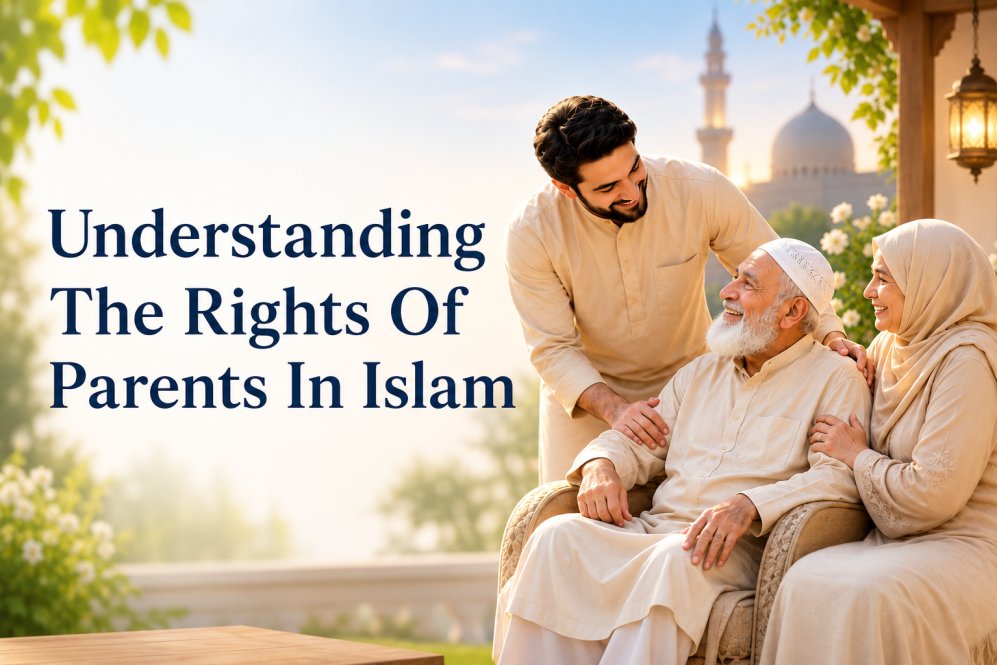
Islam places family at the heart of a believer’s character. Among the most important family relationships are those between children and their parents. The rights of parents in islam are not merely social responsibilities; they are part of worship, gratitude, and good character. The Qur’an repeatedly connects kindness to parents with devotion to Allah, showing how seriously this relationship should be treated.
Quran Verses About Parents
Among the clearest quran verses about parents are:
“And We have commanded people to ˹honour˺ their parents. Their mothers bore them through hardship upon hardship, and their weaning takes two years. So be grateful to Me and your parents. To Me is the final return.”
[Quran 31:14]
The verse clearly portrays the rights of parents in Islam.
In another verse:
“Worship Allah alone and associate none with Him. And be kind to parents, relatives, orphans, the poor,…”
[Quran 4:36]
In this verse Allah commands us to associate none with Allah and to be kind to parents primarily.
The Importance of Mother in Islam
The mother in islam has a special position because of the sacrifices associated with pregnancy, childbirth, nursing, and early care.
A man came to Allah’s Messenger (ﷺ) and said, “O Allah’s Messenger (ﷺ)! Who is more entitled to be treated with the best companionship by me?” The Prophet (ﷺ) said, “Your mother.” The man said. “Who is next?” The Prophet said, “Your mother.” The man further said, “Who is next?” The Prophet (ﷺ) said, “Your mother.” The man asked for the fourth time, “Who is next?” The Prophet (ﷺ) said, “Your father. “
[Sahih al-Bukhari 5971]
When the prophet was asked who deserves my kind companionship, He ﷺ said your mother even on asking thrice, then he said father. Even if your mother is not a Muslim be kind to your mother, Kindness is a duty.
The Prophet (ﷺ) and said:
“…Paradise lies under the feet of your mother.”
[Sunan an-Nasa’i 3104]
Ustadh Mohamad Baajour asks in his lecture, How’s your relationship with your parents? How’s your relationship with your mother? If your mother is alive, go stick to her feet. Make sure not even a day passes by when your parents are upset with you. Don’t let them go to sleep when they are mad at you. Dua from them can make you or break you.
The Apostle of Allah (ﷺ) visited the grave of his mother and he wept, and moved others around him to tears, and said: “I sought permission from my Lord to beg forgiveness for her but it was not granted to me, and I sought permission to visit her grave and it was granted to me…”
[Sahih Muslim 976b]
Hadith About Parents
The Prophet (ﷺ) said thrice, “Should I inform you out the greatest of the great sins?” They said, “Yes, O Allah’s Messenger (ﷺ)!” He said, “To join others in worship with Allah and to be undutiful to one’s parents.“
[Sahih al-Bukhari 2654]
I asked the Prophet (ﷺ) “Which deed is the dearest to Allah?” He replied, “To offer the prayers at their early stated fixed times.” I asked, “What is the next (in goodness)?” He replied, “To be good and dutiful to your parents”
[Sahih al-Bukhari 527]
These hadith about parents highlights the extraordinary care owed to mothers while also affirming the important rights of fathers.
The Role and Rights of the Father
The father in islam deserves respect, kindness, and sincere appreciation. Fathers may carry responsibilities for protection, provision, guidance, and family wellbeing, often without openly expressing the burdens they carry.
The Messenger of Allah said:
“The father is the middle gate to Paradise.”
[Jami` at-Tirmidhi 1900]
This hadith reflects the importance of father, how important it is to please father so that you may enter paradise. Subhanallah! Such a beautiful hadith indeed.
The Prophet (ﷺ) said:
“Three supplications are answered, there being no doubt about them; that of a father, that of a traveller and that of one who has been wronged.”
[Sunan Abi Dawud 1536]
This hadith opens our eyes, clearing out that though mother has great position in our lives Islamically, yet the dua or supplication of a father holds so much weight in our lives.
In another hadith regarding father, highlights the love of our beloved Prophet Muhammad ﷺ as a father,
`Uthman did not join the Badr battle because he was married to one of the daughters of Allah’s Apostle and she was ill. So, the Prophet (ﷺ) said to him. “You will get a reward and a share (from the war booty) similar to the reward and the share of one who has taken part in the Badr battle.”
[Sahih al-Bukhari 3130]
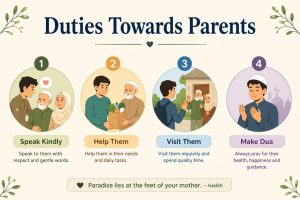
Respecting a father does not mean agreeing with every decision he makes. Rather, children should communicate respectfully, avoid unnecessary harshness, and help him when he needs support. The duties towards parents in islam include visiting them, checking on their wellbeing, helping with legitimate needs, speaking kindly, and making dua.
Obedience to Parents in Islam
Obedience to parents in islam is important, but it has limits. Islam does not require obedience in sin or disobedience to Allah. After obedience to Allah and His Messenger, it is most important to be an obedient offspring to your parents. Being polite and helpful to parents is obligatory for every Muslim.
We as children do not realize the importance of our parents until we become one. Every mother bears the pain of carrying her child during pregnancy and the childbirth. She often spends many sleepless nights patiently caring for her child’s needs. If the child is sick, parents nurse her to health. Mother has a major part in upbringing the child, while the father spends his hard earned money on her to buy her clothes, provide her food and shelter, medicine and even toys that makes the child happy.
As their children grow they try to provide him with the best education and a loving home. They are always there for them be it their first words to his graduation day, even his marriage giving him all the support, love and guidance. Even when the child makes mistakes they never stop loving him. Most of all they pray that the child grows up to be successful and happy in this life and hereafter.
The Prophet said:
“The Lord’s pleasure is in the parent’s pleasure, and the Lord’s anger is in the parent’s anger.”
[Jami` at-Tirmidhi 1899]
Allah says in the Holy Qur’an:
“But if they endeavor to make you associate with Me… do not obey them but accompany them in this world with appropriate kindness.”
(Qur’an 31:15)
This verse gives a balanced principle: a Muslim must never obey a parent in something that contradicts Allah’s commands, yet kindness and respectful companionship should continue. In other words, disagreement does not give a child permission to become rude or cruel. We should take care of them and continue to explain Islam to them clearly.
Duties Towards Parents in Islam
Parents feel so happy when their children are kind, humble, helpful and obedient towards his elders, siblings and others. If the child is rude, arrogant or disobedient, they feel disappointed and even embarrassed. The behaviour of the child is always the reflection of his parents.
When the parents become physically weak or old that they cannot take care of themselves, it is our duty to take care of them and provide them with the same love and support they gave us when we were young enough. We truly owe our lives to our parents, so we should take care of them with pleasure, without getting tired.
The Quran asks us to be kind towards our parents:
For your Lord has decreed that you worship none but Him. And honour your parents. If one or both of them reach old age in your care, never say to them even ‘ugh,’ nor yell at them. Rather, address them respectfully. And be humble with them out of mercy, and pray, “My Lord! Be merciful to them as they raised me when I was young.”
[Quran 17:23-24]

How Can We Respect Parents in Islam Today?
Respect parents in islam by simple actions. Such as:
- Call or visit them regularly.
- Listen without immediately becoming defensive.
- Help with household tasks, appointments, finances, or other genuine needs when possible.
- Be patient when they repeat themselves or need more time.
- Most importantly, remember them in dua.
The rights of parents in islam also continue after their death. A child can pray for them, give charity on their behalf where Islamically appropriate, maintain ties with their relatives, and honor the good relationships they valued. These actions keep gratitude alive even after parents are no longer physically present.
Conclusion
The parents in islam are honored because they are among the greatest means through which a person experiences care, sacrifice, upbringing, and guidance. Parents are the ones who teach us Kalima when we are born and make us strive to become a better Muslim.
Islam does not teach blind obedience or excuse injustice. Instead, it creates a relationship built on mercy, gratitude, responsibility, and faith.The rights of parents in islam remind us that honoring our parents is not something reserved for special occasions. It is reflected in how we speak, serve, forgive, and care for them (without saying an ‘uff’) every day. For a believer, respect for parents is part of living Islam with compassion.
Does Islam give the mother more rights than the father?
The Prophet ﷺ gave special emphasis to the mother, mentioning her three times before mentioning the father. This reflects her immense sacrifices, while both parents remain deserving of honour and good treatment.
Must children obey parents in every matter?
No. Children should obey parents in lawful matters. They must not obey a request that involves shirk, sin or injustice, but they should still treat their parents courteously.
How can children honour deceased parents?
They can pray for them, give charity, fulfil their commitments, maintain family ties and show kindness to their parents’ friends.
What is the best prayer for parents?
A Qur’anic prayer is: “My Lord, have mercy on them, as they raised me when I was young” (Qur’an 17:24).
What does the Qur’an say about disrespecting parents?
Qur’an 17:23 specifically forbids even expressing irritation toward elderly parents and commands believers to speak to them nobly.
What can I do for my parents every day?
Speak gently, spend time with them, help with genuine needs, appreciate their efforts, and regularly make dua.