ChatGPT
 Grok
Grok
 Perplexity AI
 Claude

In an era of climate change, pollution, and environmental degradation, the conversation around ethics and sustainability has become more serious than ever. Interestingly, the principles of Islam and environment are not new—they have been deeply rooted in Islamic teachings for over many years while the Modern Environmental Movement just began in the 1960s. It was 1400 years ago that our beloved Prophet ﷺ said, “The world is sweet and green (alluring) and verily Allah is going to install you as vicegerent in it in order to see how you act….” [Sahih Muslim 2742]
Islam presents a balanced and holistic approach to life, where humans are not owners of the Earth but caretakers or the vicegerents. This idea forms the foundation of Environmental ethics in Islam, guiding believers toward responsible and conscious living.
The Concept of Stewardship (Khalifah)
At the heart of Islamic teachings on nature lies the concept of Khalifah (stewardship). All of creation belongs to Allah. Allah has blessed us by putting us on this planet, Earth. In fact, Almighty created Earth and then He created human beings to His Khalifah (or the representative) over it. He commanded us to be in charge of the planet and all that is on it.
Quranic Insight:
“He (Allah) is the One Who has placed you as successors on earth and elevated some of you in rank over others, so He may test you with what He has given you.”
(Quran 6:165)
This verse clearly establishes that humans are entrusted with the responsibility to protect and preserve the environment. The idea of Environmental stewardship in Quran emphasizes accountability—not just in this world, but in the Hereafter.
Being a steward means:
- Avoiding waste and excess
- Protecting natural resources
- Acting responsibly toward all living beings
Balance (Mizan): The Foundation of Nature
Another key principle in Environment protection in Islam is Mizan (balance).
Quranic Insight:
“As for the sky, He raised it high, and set the balance of justice. so that you do not defraud the scales.”
(Quran 55:7-8)
This verse highlights that everything in nature is created in perfect proportion. We must remember that the resources of the Earth are limited. This means that once we use them all up, there is no more. For instance if we cut down all the trees to make furniture, paper, and even houses without planting new trees, there will come a time when there will be no more trees. This would be very bad for the whole planet and will have adverse effects on us. Trees give many things to humans and animals, of which oxygen is the most important. If all trees are used up, the Earth would slowly turn into a desert. It would then be very difficult for us to live.
Thus disrupting this balance is a violation of divine order and this teaching strongly connects with Islam and climate responsibility.
The Prophetic Model: Practical Environmental Ethics
The life of Prophet Muhammad (ﷺ) offers practical examples of Environmental ethics in Islam.
Planting Trees
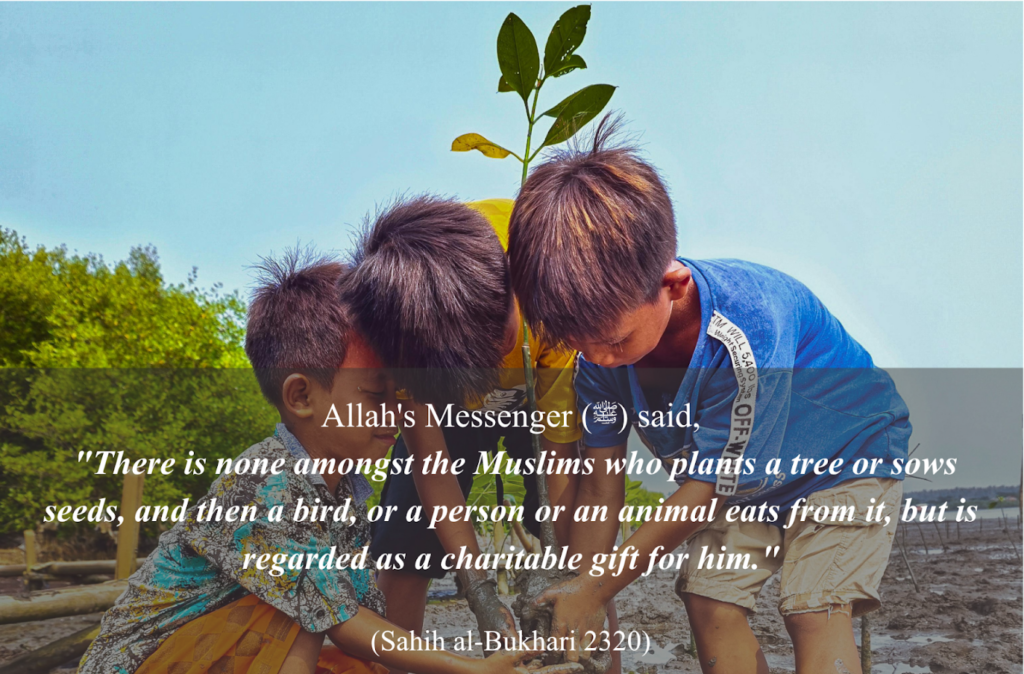
Allah’s Messenger (ﷺ) said, “There is none amongst the Muslims who plants a tree or sows seeds, and then a bird, or a person or an animal eats from it, but is regarded as a charitable gift for him.”
(Sahih al-Bukhari 2320)
This hadith beautifully reflects how Caring for earth in Islam is rewarding, encouraging sustainable actions that benefit all living beings.
Water Conservation
Even when performing ablution (wudu), the Prophet (ﷺ) advised using water in moderation.
“Do not waste water, even if you perform ablution on the banks of a flowing river.”
(Musnad Ahmad)
This is a powerful reminder of Sustainability in Islam, where conservation is emphasized regardless of abundance.
Caring for Earth in Islam
We also must be careful not to pollute the land, air, and water. Rasulullah ﷺ said that being clean is a very important part of being a Muslim. This cleanliness not only means a clean body, clothes or clean house but also means making sure that the environment around us is clean.
Few steps we can take are:
- If we see garbage in our parks or forests we should stop and pick up the mess.
- We can form or join any community to help maintain the environment clean.
- We must join together (people of neighbourhoods, towns, cities and nations) to work together to protect our planet.
Avoiding Waste (Israf): A Core Principle
Islam strictly discourages Israf (wastefulness), making it central to Islamic view on conservation.
However, we must remember that we are to take care of our planet and all that is on it. It does not belong to us and we have to treat it that way.
Allah tells us in the Quran:
“To Allah alone belongs whatever is in the heavens and whatever is on the earth. And Allah is Fully Aware of everything.” [Quran 4:126]
As the planet does not belong to us (i.e., it’s an Amanah), we have to protect it and make sure that we do not misuse or waste resources or ruin it. These days many people waste a lot of things that Allah has given us on Earth. We ignorantly cut down trees without replacing them with new trees; we throw away papers, glass, and metal all of which could be recycled and reused.
Also Allah tells us in the Quran:
“…and do not spend wastefully.Surely the wasteful are like brothers to the devils. And the Devil is ever ungrateful to his Lord.”
(Quran 17:26-27)
These strong words highlight the seriousness of wastefulness.
Scholarly Insights
Mufti Ismail Menk, Islamic Scholar brings to highlight these verses and advises us, “Just because we can afford it we can’t leave the electricity or lights or any appliance that we don’t need on at night. It is a sign of ingratitude. Be it wasting water, electricity, food or petrol we are categorised as brothers of devils.
No matter how much money we have we are not supposed to waste resources. There are so many others who need to share those resources with us on the same globe. Use what you need and let others use it as well. Imagine we need to cut one tree but end up cutting the whole forest. Simply because we can afford it we can’t ignorantly waste resources, it is extravagance and a waste.”
Whether it is food, water, or energy, unnecessary consumption goes against Environment protection in Islam.
Practical steps include:
- Reducing food waste
- Conserving electricity and water
- Choosing sustainable products
Respect for All Living Creatures
Islam promotes compassion toward animals and all forms of life.
Prophetic Teaching:
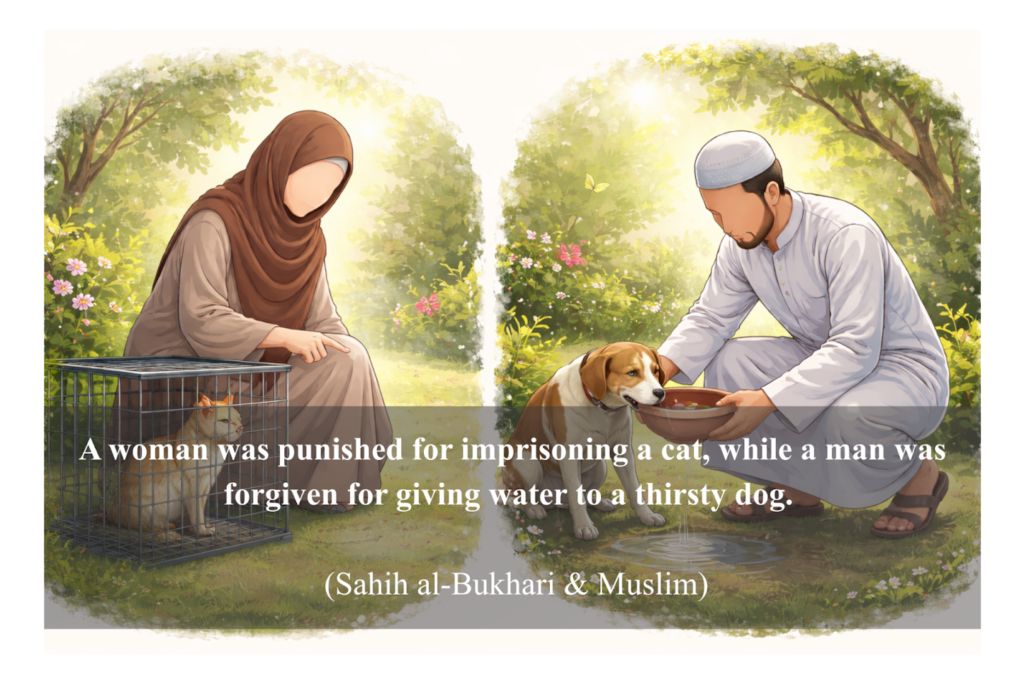
Allah’s Messenger (ﷺ) said, “A woman was tortured and was put in Hell because of a cat which she had kept locked till it died of hunger.” Allah’s Messenger (ﷺ) further said, (Allah knows better) Allah said (to the woman), ‘You neither fed it nor watered when you locked it up, nor did you set it free to eat the vermin of the earth.’ “
[Sahih al-Bukhari 2365]
In another detailed narration of a Hadith:
The Messenger of Allah (ﷺ) said, “While a man was walking on his way he became extremely thirsty. He found a well, he went down into it to drink water. Upon leaving it, he saw a dog which was panting out of thirst. His tongue was lolling out and he was eating moist earth from extreme thirst. The man thought to himself: ‘This dog is extremely thirsty as I was.’ So he descended into the well, filled up his leather sock with water, and holding it in his teeth, climbed up and quenched the thirst of the dog. Allah appreciated his action and forgave his sins”. The Companions asked: “Shall we be rewarded for showing kindness to the animals also?”
He (ﷺ) said, “A reward is given in connection with every living creature”.
[Al-Bukhari and Muslim]
These narrations show that kindness to animals is never an ignored part of Islamic teachings on nature. Every living being has a role in the ecosystem, reinforcing Sustainability in Islam.
Accountability and the Hereafter
One of the most powerful motivators in Islam and environment is accountability before Allah.
Quranic Insight:
“Then, on that Day, you will definitely be questioned about your worldly pleasures.”
(Quran 102:8)
This includes how we used natural resources. The concept of accountability strengthens Islam and climate responsibility, making environmental care a spiritual duty.
Modern Relevance: Applying Islamic Teachings Today
The timeless values of Environmental ethics in Islam can address modern environmental challenges:
| S.no. | Challenges | Steps we may take |
| 1. | Climate change | Reduce carbon footprint |
| 2. | Pollution | Promote clean living |
| 3. | Resource depletion | Encourage sustainable consumption |
Muslim communities today are increasingly adopting eco-friendly practices inspired by Islamic view on conservation.
Conclusion: A Faith-Based Approach to Sustainability
We also must be careful not to pollute the land, air, and water. Rasulullah ﷺ said that being clean is a very important part of being a Muslim. This cleanliness not only means a clean body, clothes or clean house but also means making sure that the environment around us is clean. If we see garbage in our parks or forests we should stop and pick up the mess. We can form or join any community to help maintain the environment clean. We must join together (people of neighbourhoods, towns, cities and nations) to work together to protect our planet.
The relationship between Islam and environment is deeply spiritual, ethical, and practical. Islam does not separate faith from responsibility; instead, it integrates environmental care into everyday worship.
From the Quran to the teachings of the Prophet (ﷺ), the message is clear:
Protecting the Earth is not optional—it is a trust (Amanah).
By embracing Caring for our planet earth in Islam, we not only fulfill our religious duty but also contribute to a better, more sustainable world for our future generations.
How does Islam promote sustainability?
Through teachings against waste (Israf), encouragement of conservation, and ethical use of resources, sustainability in Islam is strongly emphasized.
Are there Quranic verses about the environment?
Yes, verses like Quran 6:165 and 55:7-8 highlight stewardship and balance in nature.
What is the Islamic view on climate change?
While not mentioned explicitly, Islam and climate responsibility can be understood through principles of balance, accountability, and stewardship.