ChatGPT
 Grok
Grok
 Perplexity AI
 Claude

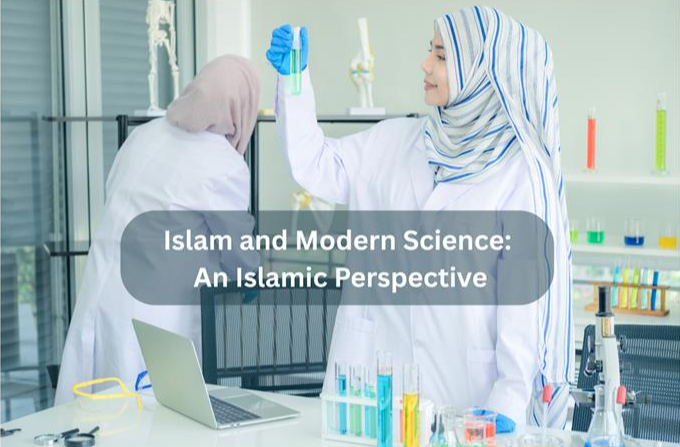
In today’s rapidly evolving world, discussions about Islam and science are more relevant than ever. From artificial intelligence to space exploration, scientific innovations and discovery continue to reshape human life. But where does Islam stand in this journey of knowledge? Is there a conflict, or is there a deeper connection rooted in faith?
This blog explores the Islam and modern science connection through Quranic guidance, Prophetic teachings, and the historical contributions of Muslim scholars. Let’s unfold how faith and reason walk hand in hand in Islam—without exaggeration or forced interpretations or false information.
Islam Encourages the Pursuit of Knowledge
The first revelation sent to Prophet Muhammad ﷺ began with a command to read that changed human history:
“Read, ˹O Prophet,˺ in the Name of your Lord Who created”
(Quran 96:1)
This verse establishes a powerful foundation for knowledge and science in Islam. Knowledge (‘Ilm) is not optional in Islamic teachings; it is a sacred duty. Seeking knowledge is obligatory for every Muslim, be it men or women. The Quran repeatedly invites people to reflect, think, and observe.
“Indeed, in the creation of the heavens and the earth and the alternation of the day and night there are signs for people of reason.”
(Quran 3:190)
Such verses highlight the deep Quran and science relationship, encouraging believers to explore the natural world as a sign (Ayah) of Allah’s wisdom.
The Prophet ﷺ further emphasized this mindset:
“Seeking knowledge is a duty upon every Muslim”
(Sunan Ibn Majah 224)
This Hadith lays the seed for scientific thinking among Muslims, showing that intellectual growth is an important part of worship when done with sincerity.
Harmony Between Faith and Discovery
A common misconception suggests religion restricts scientific progress. However, the Islamic perspective on science views knowledge as complementary to faith—not contradictory.
The Quran frequently asks rhetorical questions that inspire inquiry:
“Do they not look at the camels—how they are created?”
(Quran 88:17)
This verse invites observation, investigation, and curiosity—core elements of science.

Many scholars speak about the harmony between Islam and science, explaining that Islam provides moral guidance while science explains mechanisms of the universe. Faith answers why we exist; science often explains how things function.
Muslim Scholars and Science: A Historical Reality
During the Islamic Golden Age, Muslim scholars made groundbreaking contributions in medicine, astronomy, mathematics, and chemistry.
- Ibn Sina (Avicenna) authored The Canon of Medicine, used in Europe for centuries.
- Al-Khwarizmi laid the foundation of algebra.
- Ibn al-Haytham developed early scientific methodology through experimentation.
These contributions demonstrate the vibrant role of Muslim scholars in science throughout history. Their work reflects the practical application of the Islamic view on scientific discoveries—to benefit humanity while acknowledging the Creator.
Quranic Reflections on Nature and Science
The Quran is not a textbook of science, but it contains verses that encourage reflection on natural phenomena.
1. Creation of the Universe
“We built the universe with ˹great˺ might, and We are certainly expanding ˹it˺.”
(Quran 51:47)
Many interpret this verse as consistent with the expanding universe concept, showing an intriguing aspect of the Quran and science connectivity.
About the celestial objects Allah says and its orbit, “It is not for the sun to catch up with the moon, nor does the night outrun the day. Each is travelling in an orbit of their own.” (Quran 36:40)
About the galaxy, “And We have made the sky a well-protected canopy, still they turn away from its signs.And He is the One Who created the day and the night, the sun and the moon—each travelling in an orbit.” (Quran 21:32-33)

Scientists discovered that the heaven and the earth were once conjoined but later they were split into two which is already mentioned in the Quran,
“Do the disbelievers not realize that the heavens and earth were ˹once˺ one mass then We split them apart? (Quran 21:30)
2. Development of the Human Being
“For indeed, We alone created humans from a drop of mixed fluids, in order to test them, so We made them hear and see.”
(Quran 76:2)
The stages of embryonic development described in the Quran have drawn attention from researchers studying human biology.
“And indeed, We created humankind from an extract of clay. then placed each ˹human˺ as a sperm-drop in a secure place, then We developed the drop into a clinging clot, then developed the clot into a lump ˹of flesh˺, then developed the lump into bones, then clothed the bones with flesh, then We brought it into being as a new creation. So Blessed is Allah, the Best of Creators.” (Quran 23:12-14)
Humankind was created from clay. There is no evidence that claims we evolved from monkeys. It is just a bogus theory which lacks any truth or sign. While it’s in our Holy book, “Who has perfected everything He created. And He originated the creation of humankind from clay.” (Quran 32:7)
3. Amazing Creation from Water
“And We created from water every living thing. Will they not then believe?” (Quran 21:30)
Scientific insights tell us that the human body is made of cells. Each cell has cytoplasm. The cytoplasm is made of 80% water.
Other creatures are also made of water, it’s not limited to humans, “And Allah has created from water every living creature. Some of them crawl on their bellies, some walk on two legs, and some walk on four. Allah creates whatever He wills. Surely Allah is Most Capable of everything.” (Quran 24:45)

About the two water bodies that don’t mix up Allah says, “And He is the One Who merges the two bodies of water: one fresh and palatable and the other salty and bitter, placing between them a barrier they cannot cross.” (Quran 25:53)
4. Quran and Genetic Science
There is no difference between Modern Science and Islam Islam is not against science.
We all are created in pairs as said in the Quran earlier. “And We created pairs of all things so perhaps you would be mindful.” (Quran 51:49)
We never even imagined that plants and animals also have genes. There are males and females and they reproduce before it was acknowledged in the Quran,
“He (Allah) is the one who sends down rain from the sky, causing various types of plants to grow” (Quran 20:53) and later on Scientists also affirmed. Be it plants, animals, or humans or any other thing which is hidden from our knowledge till now.
“Glory be to the One Who created all ˹things in˺ pairs—˹be it˺ what the earth produces, their genders, or what they do not know!” (Quran 36:36)
Also this verse affirms the embryology, “And He is the One Who creates human beings from a ˹humble˺ liquid, then establishes for them bonds of kinship and marriage. For your Lord is Most Capable.” (Quran 25:54)
4. Transition of Day and Night
About the day and night Allah says, “There is also a sign for them in the night: We strip from it daylight, then behold! they are in darkness.” (Quran 36:37)
This verse subtly points to:
- The precision of Earth’s rotation (24-hour cycle).
- The delicate balance which is necessary for life.
- The ordered system controlling the universe.
Rather than giving a scientific textbook explanation, the Qur’an invites reflection on a daily phenomenon that humans often ignore.The alternation of night and day is presented not just as a natural event — but as a sign (āyah) of divine design and control.
Also there’s revelation about the sunrise, that the sun rises only from one direction (the east) and not from varied directions. Then it gradually travels from that direction to its opposite (i.e., the sunset at the east).

“The sun travels for its fixed term. That is the design of the Almighty, All-Knowing.” (Quran 36:38)
However, the Islamic perspective on science cautions against forcing modern theories into verses. Instead, Muslims are encouraged to reflect, not distort meanings.
Islam and Ethical Boundaries in Modern Science
While Islam and modern science share harmony in seeking knowledge, Islam provides ethical guidelines.
For example:
- Genetic engineering must not violate human dignity.
- Artificial intelligence must serve justice, not oppression.
- Environmental research should protect Allah’s creation.
The Quran reminds believers:
“Do not spread corruption in the land after it has been set in order.”
(Quran 7:56)
Thus, the Islamic view on scientific discoveries includes moral accountability. Scientific advancement should improve man life—not exploit it. It should not disturb the natural phenomenon at any cost.
Does Islam Support Science? A Balanced Answer
When people ask, does Islam support science, the answer lies in both scripture and history. Islam encourages exploration, research, and innovation—but within ethical boundaries.The Holy Book of Quran which Allah has given us 1400 years ago is a book of miracles. It has all the evidence and proof that scientists have been discovering lately. It is not a book of science but a book of signs.
The Prophet ﷺ once said:
“You know better about your worldly affairs.”
(Sahih Muslim 2363)
This Hadith indicates that worldly knowledge, including scientific research, falls within human responsibility. It supports practical inquiry and experimentation.
Scholarly Insights
The relationship between Islam and modern science is not built on blind acceptance nor rigid denial. It is a balanced partnership guided by purpose.
Scholar Mufti Tariq Masood says in his speech while talking about Islam and science, scientists have discovered that our fingerprints are unique i.e., None of our fingerprints are the same be it siblings or the biological parents. But the Quran has that fact already written in it. Which is:
“Do people think We cannot reassemble their bones?Yes ˹indeed˺! We are ˹most˺ capable of restoring ˹even˺ their very fingertips.” (Quran 75:3-4)
It is evident that fingerprints are unique features in the human body which can’t be restored by any human power or the technology but Allah, the creator of this Universe can restore it if he wants.
Scientific Thinking in Islam Today
In today’s world, Muslims are actively contributing towards medicine, engineering, space research, and environmental science. The spirit of scientific thinking in Islam continues to progress as curiosity meets faith.
The challenge is not whether Islam aligns with science, but whether Muslims revive their intellectual legacy. Rediscovering the alignment between Islam and science can inspire future generations to innovate new ideas and come up with the latest scientific solutions while staying spiritually grounded.
A Faith That Encourages Reflection
The Quran repeatedly invites reflection:
“Say, are those who know equal to those who do not know?”
(Quran 39:9)
This rhetorical question alone summarizes the Islamic perspective on knowledge. Knowledge elevates humanity. Ignorance limits it.
Ultimately, modern science and Islam are not enemies. They operate in different yet complementary domains. Science explores creation. Islam connects creation to its Creator.
When guided rightly by faith and ethics, scientific progress becomes an act of gratitude.
Conclusion
The discussion around Islam and modern science should move beyond stereotypes. Islam does not fear discovery; it encourages it. The Quran promotes observation, reflection, and reasoning. The Prophet ﷺ valued knowledge. Muslim scholars historically led global innovation.
The real question is not whether Islam conflicts with science—but how believers can responsibly integrate faith with modern advancements.
By nurturing curiosity and maintaining ethical principles, Muslims can contribute meaningfully to today’s scientific world while still remaining spiritually rooted.
What is the Quran and science relationship?
The Quran encourages observation of nature as signs of Allah, promoting inquiry rather than rejecting knowledge.
How did Muslim scholars contribute to science?
Scholars like Ibn Sina and Al-Khwarizmi made foundational contributions in medicine and mathematics during the Islamic Golden Age.
Is there harmony between Islam and science today?
Yes, when science is practiced ethically and responsibly, there is clear harmony between Islam and science.
What is the Islamic view on scientific discoveries?
Discoveries are welcomed as long as they benefit humanity and align with moral teachings.
What does the Quran say about science?
It invites observation, like signs in horizons (41:53), strengthening the Quran and science relationship.