ChatGPT
 Grok
Grok
 Perplexity AI
 Claude


Islam provides guidance not only for spiritual life but also for economic behavior. Wealth in Islam is considered a trust from Allah, and how a person earns, spends, and distributes it has moral and spiritual consequences. The Islamic finance principles aim to create a fair, ethical, and socially responsible economic system that benefits individuals and society.
Over the last few decades, the muslims have been trying to restructure their lives on the basis of Islamic principles. We strongly feel that the political and economic dominance by the West has deprived us of divine guidance, especially in the socio-economic fields.
In the economic field, it was the biggest challenge for Muslims to reform their financial institutions to be in harmony with the laws of Shari’ah. In an era where the entire finance system was based on interest, it was a formidable task to structure the financial institutions on an interest free basis, while promoting justice and compassion. This article introduces the foundations of halal financial practices based on the Qur’an and the teachings of Prophet Muhammad ﷺ.
Understanding the Principles of Islamic finance
Islam has a clear cut principle for the financier. According to those principles, a financier must determine whether he is advancing a loan to assist the debtor on a humanitarian basis or he desires to share the profits.
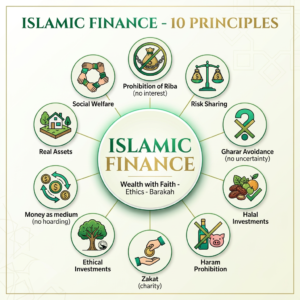
These finance principles are rooted in the Qur’an and Sunnah. They emphasize justice, transparency, risk-sharing, and ethical responsibility in financial dealings. Islam does not view wealth as something negative; rather, it encourages lawful earnings while discouraging exploitation or injustice.
Allah says in the Qur’an:
“O you who believe! Do not consume one another’s wealth unjustly, but only [in lawful] business by mutual consent.”
(Qur’an 4:29)
This verse highlights a key foundation of Ethical finance in Islam—transactions must be fair and voluntary.
Another important principle is accountability. Muslims believe that their financial actions will be judged by Allah. The Prophet Muhammad ﷺ said:
“”The feet of the slave of Allah shall not move [on the Day of Judgement] until he is asked about five things: about his life and what he did with it, about his knowledge and what he did with it, about his wealth and how he earned it and where he spent it on, about his body and for what did he wear it out.”
[Jami` at-Tirmidhi 2417]
Thus, halal wealth involves both lawful earning and responsible spending.
Halal earning in Islam
One of the pillars of the Islamic finance principles is earning wealth through lawful and ethical means. Halal earning means that income must come from permissible activities that do not harm others or violate Islamic teachings.
Islamic Shari’ah teaches us which earnings are Halal and which ones are Haram. Islamic Shari’ah is a vast field of study and has special experts who spend their lives in its study and teaching. Shari’ah is a complete way of life. Islamic Shari’ah is an unlimited source of guidance to the laws of Allah.
Islam asks us to adopt Halal means of earning a living. The Messenger of Allah (ﷺ) said:
“O people, fear Allah and be moderate in seeking a living, for no soul will die until it has received all its provision, even if it is slow in coming. So fear Allah and be moderate in seeking provision; take that which is permissible and leave that which is forbidden. “
[Sunan Ibn Majah 2144]
Allah blesses the Halal earnings. The earnings which are Halal are:
- Earnings by offering services in terms of salary.
- A fee for Halal service.
- The profits earned by a Halal business
- Produce and sales from one’s land.
- Money and property which one rightfully inherits or receives as a gift.
The Prophet (ﷺ) was asked, ‘What type of earning is best?’ He ﷺreplied, “A man’s work with his hand and every transaction which is free from cheating or deception.” [Reported by al-Bazzar; al-Hakim graded it Sahih (authentic)].
An acceptable business is one which is conducted honestly. A businessman should be honest and fair in his dealings. He or She should not over-charge people and must not give them less than their full measure.
Quran clearly says:
“Give full measure, and cause no loss ˹to others˺.Weigh with an even balance,and do not defraud people of their property. Nor go about spreading corruption in the land.”
[Quran 26:181-183]
The examples of Haram businesses are:
- Producing and selling alcohol and other intoxicants.
- Dealing in pork products; bad videos, movies, books plus anything that’s forbidden in Islam.
- Dealing with usury (making money by loan money with fixed interest rates)
- Earning money in gambling and other games of chance.
- Earning from forbidden services like fortune telling by any means, magic and sorcery.
Thus, Islam has two conditions of Halal earnings:
- It must be earned through Halal means.
- It must be earned through honest work.
This teaching highlights dignity in work and reinforces the moral responsibility tied to wealth.
From agriculture and trade to modern professions, Halal earning in Islam promotes productivity while maintaining ethical boundaries.
Riba in Islam: Why interest is prohibited
One of the most well-known aspects of Islamic finance principles is the prohibition of Riba in Islam, which refers to interest or unjustified financial gain.
The Qur’an strongly condemns it:
“Those who consume interest will stand on Judgment Day like those driven to madness by Satan’s touch. That is because they say, “Trade is no different than interest.” But Allah has permitted trading and forbidden interest. Whoever refrains—after having received warning from their Lord—may keep their previous gains, and their case is left to Allah. As for those who persist, it is they who will be the residents of the Fire. They will be there forever.”
(Qur’an 2:275)
This verse clearly elaborates how Allah dislikes Riba (interest money), how we are warned against it, to refrain from it. What will be our end if we never give up on Riba.
In another verse, Allah warns believers:
“O believers! Fear Allah, and give up outstanding interest if you are ˹true˺ believers.”
(Qur’an 2:278)
The prohibition exists because interest-based systems often lead to exploitation, widening economic inequality and placing unfair burdens on borrowers.
Instead, Interest free finance in Islam encourages risk-sharing partnerships where profits and losses both are shared fairly. This approach supports cooperation rather than exploitation.
Zakat in Islam and wealth purification
A key component of the Islamic economic system is Zakat. Giving Zakat is a pillar of Islam, and it is obligatory for Muslims to give Zakat or Zakah an Arabic word which means to purify something. By giving it we purify our wealth. Allah blesses our wealth and often causes it to increase.
The Zakat in Islam means to share our wealth that has been given to us by Allah with those in need and are poor.. It is the right of needy Muslims to share in the wealth of those whom Allah has blessed with more than what meets their needs.
“and who give the rightful share of their wealth to the beggar and the poor”
[Quran 70:24-25]
Zakat serves multiple purposes:
- Purifies wealth
- Helps the poor and needy
- Reduces economic inequality
- Strengthens community bonds
Zakat purifies our wealth and there is Barakah in giving. The Quran commands:
“Take from their wealth O Prophet charity to purify and bless them, and pray for them” [Quran 9:103]
Zakat is an obligation for every adult Muslim, if he or she has a Nisaab. The Nisaab is the minimum amount of wealth that one must possess before one is obligated to pay Zakat.
Some of the items for which we must pay the Zakat:
- Money, silver and gold
- Land and property
- Animals
- Grains, vegetables and fruit crops.
The calculation of Zakat on different types of wealth is a highly sophisticated science whose details are seen in Fiqh books.However, the zakah for money is 2.5% of one’s savings for the year. The Zakah becomes Fard for a person who possesses wealth according to Nisaab or more than that for one complete year. If a Muslim is in debt, he should pay off the debt first. The payment of debt is a very important religious duty of a believer. If a Muslim’s debts are in excess of the Nisaab of the Zakat, he must prioritize paying off his debts.
Who can receive Zakat?
Allah has described eight categories of people in the Quran who can receive the Zakat:
“Alms-tax is only for the poor and the needy, for those employed to administer it, for those whose hearts are attracted to the faith, for freeing slaves, for those in debt, for Allah’s cause, and for needy travellers. This is an obligation from Allah. And Allah is All-Knowing, All-Wise.” [Quran 9:60]
The Zakat can be given to the needy person who depends on others for support. The needy may include:
- The handicapped
- The orphans
- The widows, or
- Those who are in temporary need.
Who cannot receive Zakat?
Tha Zakat money is specifically for the Muslim community.
The non-Muslims could be helped by other sources like the Sadaqah and gifts.
Anyone from the family of the Prophet Muhammad ﷺ cannot receive the Zakah. We may help them through other means like gifts.
Our immediate family members cannot receive Zakah (because it is our obligation to take care of our family and close relatives).
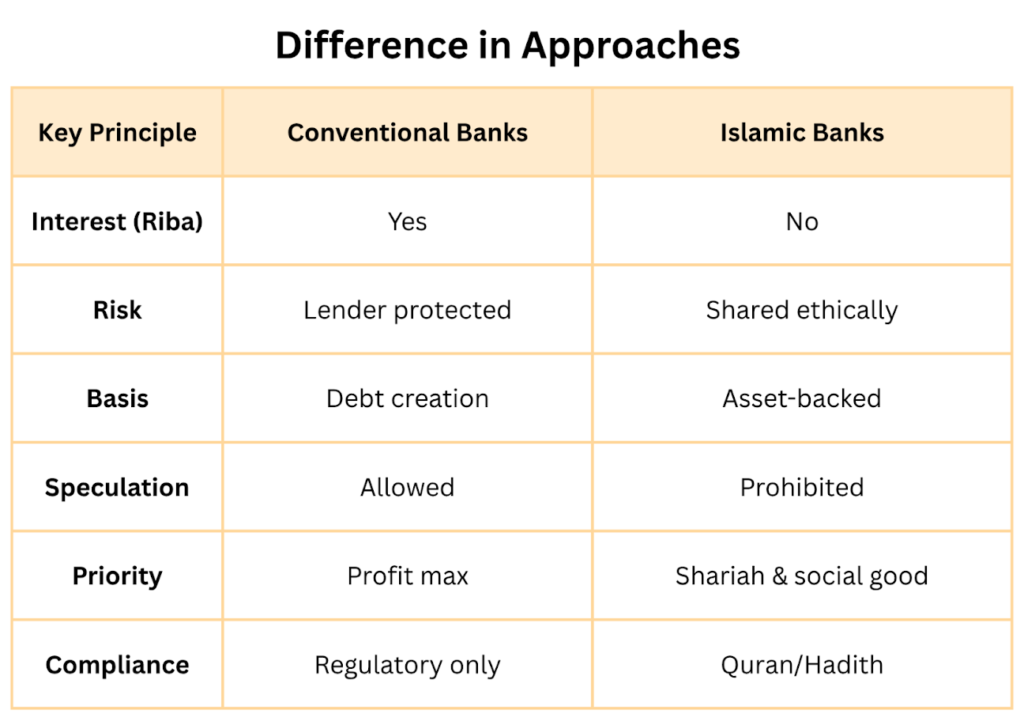
Islamic banking basics
Modern financial institutions have begun incorporating Islamic banking basics to accommodate Muslims who want financial services aligned with Islamic teachings.
Unlike conventional banks, Islamic banks operate on principles such as:
- Profit-and-loss sharing
- Asset-backed financing
- Avoidance of interest-based transactions
- Ethical investment policies
Some common Islamic finance models include:
Murabaha – cost-plus financing for purchasing goods
Mudarabah – partnership between investor and entrepreneur
Musharakah – joint investment partnerships
Scholarly insights
Mufti Muhammad Taqi Usmani is an Islamic jurist and leading scholar. He is a world-renowned authority in Islamic finance, serving as chairman or member of Shariah supervisory boards for several global Islamic banks. Lets see what He says about these Islamic finance models in one of his books.
Murabaha is a specific kind of sale where the commodities are sold on a cost-plus basis. This kind of sale is being adopted by the contemporary Islamic banks and financial institutions as a mode of financing. They purchase the commodity for the benefit of their clients, then sell it to them on the basis of deferred payment at an agreed margin of profit added to the cost.
Mudarabah is a special type of partnership where one partner invests money in a commercial enterprise. The investing partner is called “rabb-ul-mal”, while the management and responsibility of work is fulfilled by the other partner, who is called “mudarib”.
Musharakah is an Arabic word, means sharing. In the context of business and trade it means a joint enterprise in which all the partners share the benefit or loss of the joint venture. It is an ideal alternative for the interest-based financing with far reaching effects on both production and distribution. Islam has strictly prohibited interest, and it cannot be used for providing funds of any kind.
The difference between two Islamic finance models can be interpreted as:
| S. No. | Musharakah | Mudarabah |
| 1. | Investment comes from all partners. | Investment comes only from rabb-ul-mal. |
| 2. | All partners can work and manage the business. | Only mudarib can work and manage the business. |
| 3. | All partners share the loss to the extent of their investment ratio. | The loss is shared by the rabb-ul-mal only |
| 4. | If the liabilities of the business exceed its assets and the business goes into liquidation, all the exceeding liabilities shall be borne pro rata by all the partners. | The liabilities of rabb-ul-mal is limited to his investment unless he has permitted mudarib to incur debts on his behalf. |
| 5. | All the assets become jointly owned by all of the partners. | All the assets are solely owned by the rabb-ul-mal. |
These systems support Interest free finance Islam while enabling business growth and economic development.
Halal investment in Islam
Investment is allowed in Islam, maintaining that it aligns with Islamic finance principles and avoids prohibited sectors such as gambling, alcohol, or unethical industries.
Halal investment in Islam focuses on:
- ethical businesses
- real economic activity
- risk sharing
- transparency
This aligns closely with Ethical finance in Islam, which prioritizes moral values alongside profit.
By investing responsibly, Muslims contribute to a balanced and socially responsible Islamic economic system.
Spending wealth responsibly in Islam
Islam does not only regulate earnings; it also guides how wealth should be spent.
The Qur’an instructs believers to avoid extravagance:
“Eat and drink, but do not be excessive. Indeed, He does not like those who commit excess.”
(Qur’an 7:31)
Responsible spending includes:
- supporting family
- giving charity
- avoiding wastefulness
- helping those in need
These values reflect the balanced nature of the Islamic finance rules, ensuring wealth benefits both individuals and society.
Conclusion
Islam offers a comprehensive economic framework that balances personal prosperity with social justice. The Islamic finance principles emphasize ethical earning, responsible spending, and community welfare.
Ultimately, the goal of Ethical finance in Islam is not merely wealth accumulation but achieving fairness, compassion, and accountability in economic life.
Why is Riba in Islam prohibited?
Riba or Interest in Islam is prohibited because it leads to exploitation and economic injustice, while Islam encourages fair trade and shared financial risk.
How does Zakat in Islam help society?
Zakat in Islam redistributes wealth, supports the poor, and reduces economic inequality within the community.
What are Islamic banking basics?
Islamic banking basics include profit-sharing, asset-backed financing, and interest-free financial transactions that comply with Islamic teachings.
What is Halal investment in Islam?
Halal investment in Islam refers to investing in ethical businesses that comply with Islamic rules, avoid prohibited industries and seek barakah through honesty.
How does zakat in Islam work?
It's just 2.5% of eligible wealth annually, purifying assets and aiding the needy (Quran 9:103).