ChatGPT
 Grok
Grok
 Perplexity AI
 Claude

How to practice gratitude comes down to one simple habit deliberately noticing what’s still good, even when life is hard. It doesn’t require perfect circumstances, a special routine, or a lot of time. It requires consistent attention to small, specific things that are easy to overlook. Whether you have little or a lot, the practice works the same way: start small, be specific, and keep showing up.
Why Is Gratitude Important Or Is It Just Feel-Good Advice?
Gratitude is important because it breaks the mental loop of focusing only on what’s missing and trains your brain to see the full picture, not just the painful parts.
Honestly? A lot of people roll their eyes at gratitude talk. And fair enough it can sound like a privileged suggestion. “Just be thankful!” is easy to say when your bills are paid and your family is healthy.
But why gratitude is important goes deeper than positivity culture. Gratitude isn’t about pretending. It’s about widening your field of vision when life has narrowed it down to your problems.
When someone focuses only on what’s missing, their thinking gets trapped in a loop. Every setback confirms the pattern. Every small win gets ignored. Gratitude cracks that loop open. Not by lying to yourself, but by making sure you’re seeing the full picture, not just the painful parts.
People who genuinely practice it tend to recover from setbacks faster. They sleep better. They fight less. They stay in relationships longer not because life is easier for them, but because they’ve trained themselves to notice what’s still worth holding onto.
What Are the Real Benefits of Being Thankful That Nobody Talks About?
The benefits of being thankful include better sleep, stronger relationships, lower anxiety, and a more resilient mindset most of which build quietly over time, not overnight.
Here’s something the motivational posts leave out: the benefits of being thankful are not always immediate, and they don’t always feel good at first.
In the beginning, forcing yourself to find something to be grateful for when you’re exhausted or heartbroken can feel almost offensive. Like you’re minimizing your own pain. But that resistance is actually part of the process.
Over time, the benefits start compounding quietly:
- You stop waiting for life to be “better” before you allow yourself to feel okay
- Small things start registering more a good conversation, a sunny afternoon, a meal that actually tasted nice
- You become harder to rattle, because you’ve built an internal reference point that isn’t tied to external outcomes
- Your relationships shift people feel seen by you, because grateful people pay attention
- Oddly, you become more ambitious, not less because contentment and drive aren’t opposites.
The last point surprises most people. But gratitude doesn’t make you complacent. It makes you stable enough to actually pursue what matters.
How Does Gratitude Change Your Life When You’re Barely Holding On?
Gratitude changes your life by giving you somewhere to stand while dealing with hardship. It doesn’t erase the pain, but it keeps you from being completely swallowed by it.
This is the real test. How gratitude changes your life when things are genuinely falling apart is not the same as how it works during a good season.
When you’re barely holding on financially, emotionally, physically, gratitude isn’t a mood. It’s a lifeline. And it works differently.
It doesn’t make the hard thing disappear. It gives you somewhere to stand while you deal with it.
A woman who went through a divorce she didn’t want once told me she started keeping a tiny notebook. Not for big things. Just for moments. A stranger who held the door. A song that came on at exactly the right time. Her kid was laughing at something ridiculous. She said, “I wasn’t okay. But I had proof that okay moments still existed. That kept me moving.”
That’s what gratitude does in hard seasons. It keeps the evidence visible that the world isn’t entirely against you, even when it feels that way.
How to Practice Gratitude Daily Without It Feeling Like a Chore?
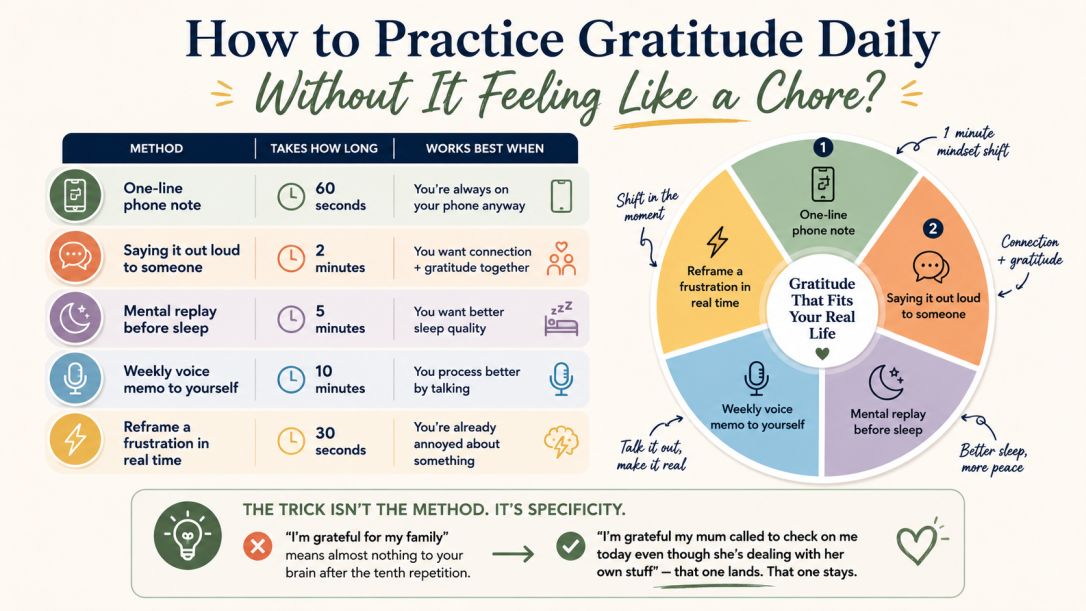
You can practice gratitude daily by choosing one small, specific method that fits your existing routine. Consistency matters far more than the technique you pick.
Most advice on how to practice gratitude daily sounds like homework. Journal every morning. Meditate for 20 minutes. List five things before bed. And sure those work, if you actually do them. But most people don’t, because real life is messy.
Here’s what actually tends to stick:
| Method | Takes How Long | Works Best When |
| One-line phone note | 60 seconds | You’re always on your phone anyway |
| Saying it out loud to someone | 2 minutes | You want connection + gratitude together |
| Mental replay before sleep | 5 minutes | You want better sleep quality |
| Weekly voice memo to yourself | 10 minutes | You process better by talking |
| Reframe a frustration in real time | 30 seconds | You’re already annoyed about something |
The trick isn’t the method. It’s specificity. “I’m grateful for my family” means almost nothing to your brain after the tenth repetition. “I’m grateful my mum called to check on me today even though she’s dealing with her own stuff” that one lands. That one stays.
How Do You Stay Thankful in All Circumstances, Including the Worst Ones?
Staying thankful in all circumstances means starting embarrassingly small not with sunsets or big blessings, but with one true thing from today that wasn’t completely terrible.
Nobody wants to hear this, but how to be thankful in all circumstances sometimes means starting with something embarrassingly small.
Not the sunset. Not your health. Not your family. Sometimes it’s just: the coffee was hot. The headache went away by noon. The queue at the shop moved faster than expected.That’s not settling. That’s training your attention to stay open when everything in you wants to shut down.
A few things that genuinely help when circumstances are brutal:
- Don’t force the feeling to find the fact. You don’t have to feel grateful. Just look for one true thing that wasn’t terrible today.
- Let someone else reflect it back to you. Sometimes you can’t see what you still have. Someone who loves you can.
- Separate gratitude from acceptance. You can be grateful for something and still want things to change. They’re not the same thing.
- Start a “still” list. Not what you have, what you still have. Still healthy. Still speaking. Still here.
Gratitude in suffering is quiet. It doesn’t announce itself. But it shows up, if you’re willing to look sideways instead of only straight at the pain.
Why Is It Important to Be Thankful for What Allah Has Given You?
Gratitude is one of the qualities Allah loves most in a believer. Being thankful means recognizing that every blessing whether great or small comes from Him. It is easy to promise generosity and faithfulness when we hope for more, but true gratitude is revealed after we receive those blessings. The Qur’an warns against becoming selfish or forgetting Allah once our prayers are answered. Instead, believers are encouraged to remain humble, fulfill their promises, help those in need, and continue thanking Allah in every circumstance. A grateful heart not only brings peace and contentment but also strengthens one’s relationship with Allah.
| “And of them are some who made a covenant with Allah [saying]: ‘If He bestowed on us of His Bounty, we will verily, give Sadaqah [Zakah and voluntary charity in Allah’s Cause] and will certainly be among those who are righteous.’ Then when He gave them of His Bounty, they became niggardly [refused to pay the Zakah or voluntary charity], and turned away, averse.” (Qur’an 9:75–76) |
Final Thoughts
Here’s an honest conclusion: in the beginning, gratitude is almost always a choice. A deliberate, sometimes uncomfortable, occasionally annoying choice. But if you stay with it long enough, something shifts. It stops feeling like a task and starts feeling like a reflex.
That’s the actual goal of learning how to practice gratitude not to feel grateful every second, but to reach a point where your brain automatically scans for what’s good, even in the middle of what’s hard. You’ll still have bad days. You’ll still miss what you’ve lost. But underneath all of that, there’ll be something steady, a quiet, stubborn awareness that some things are still worth being here for.Start small. Stay consistent. And trust that noticing really noticing is enough.
How to Be Content With What You Have?
Contentment isn't settling, it's refusing to put your peace on hold until everything is perfect. Your current life, messy as it is, still deserves your full attention.
How to Be Grateful for What You Have?
Before you sleep, name three ordinary things that could have been worse but weren't. Do that for a week. Your brain quietly stops scanning for problems and starts catching what's going right.
How to Appreciate What You Have?
Spend thirty seconds imagining your day without something you barely notice running water, a working phone, someone who checks on you. Appreciation is just attention with warmth attached.
Does Gratitude Actually Help With Anxiety and Overthinking?
It doesn't silence anxious thoughts, it gives your mind somewhere else to land. Over time, the mental default shifts from "what's going wrong" to "what's still okay."
Can Children Be Taught to Practice Gratitude?
Absolutely and early. It starts with simple language at home. Kids who grow up hearing gratitude spoken out loud tend to carry that habit naturally into adulthood.