ChatGPT
 Grok
Grok
 Perplexity AI
 Claude

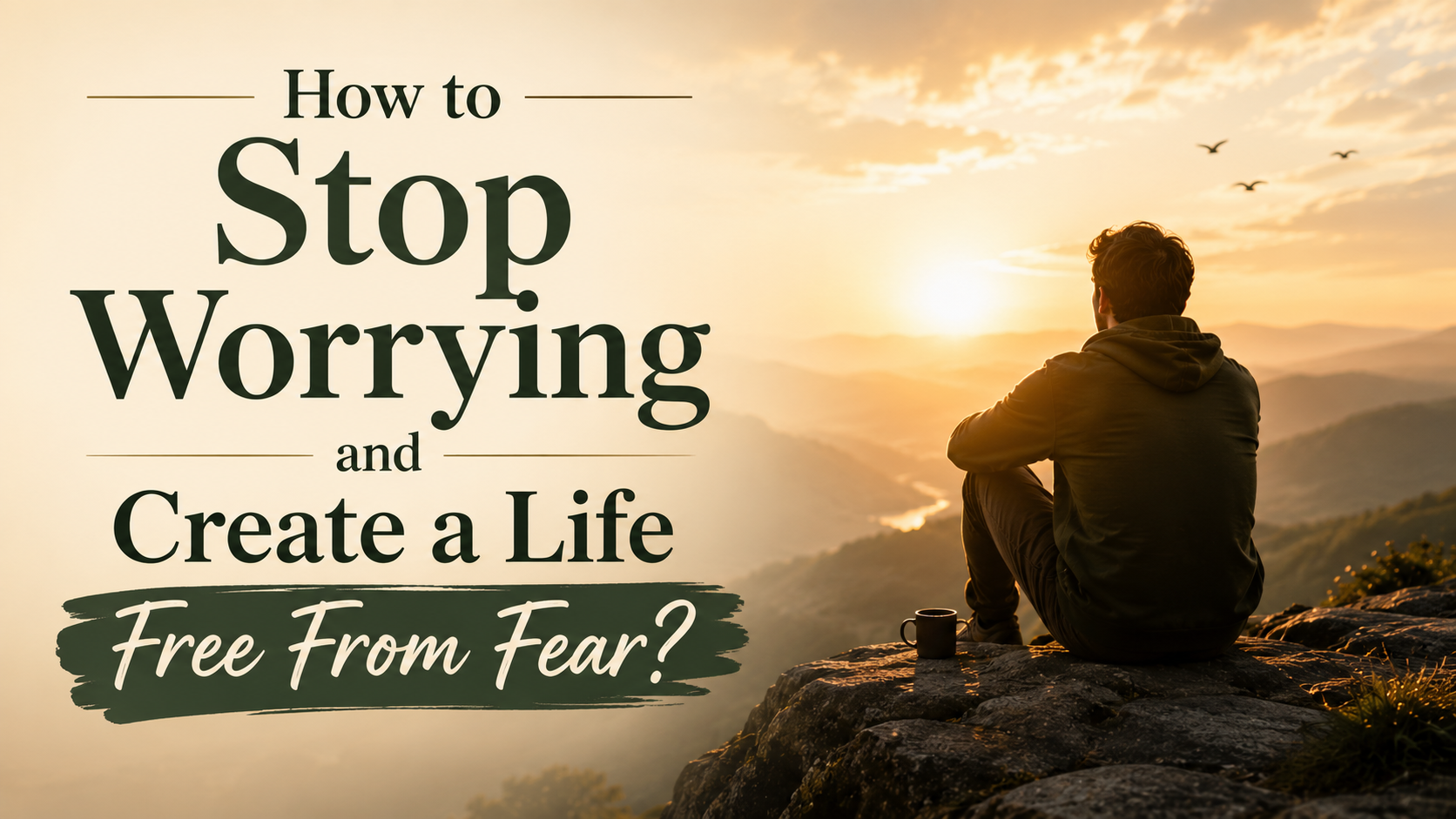
You can’t erase worry completely. That’s not how brains work but you can shrink how often it shows up and how fast it leaves once it does. The core moves: sort your worries into “things I can act on” vs. “things I can’t touch,” question catastrophic predictions before you believe them, face one small fear at a time instead of avoiding it, and give nighttime overthinking a scheduled slot during the day instead of letting it run loose at 2 a.m. It’s not a single fix, it’s a stack of small, repeated choices that compound over weeks, not minutes.
It’s 2 a.m. and you’re replaying a conversation from three days ago. Or maybe your stomach just dropped over something that hasn’t even happened yet. Either way, you know exactly how draining worry gets. Here’s the thing about how to stop worrying it’s not a switch you flip.
You don’t wake up one day as some calm, unbothered version of yourself who never gets nervous again. It happens slower than that. Messier too. But it does happen. No personality transplant required. Just a handful of small, honest shifts in how you think, react, and talk to yourself when fear barges in uninvited and decides to stick around longer than it should.
Why Do We Worry About Everything in the First Place?
Worry is outdated survival wiring your brain still flags an unanswered email the way it would once flag a predator.
Honestly, worry isn’t some flaw in your wiring. It’s leftover survival gear ]the same instinct that once kept people scanning the tree line for predators instead of getting comfortable by the fire. The problem is, nobody updated the software. Your brain still treats an unanswered email like a wolf in the bushes.
That’s basically why people end up worrying about everything, the tiny stuff right alongside the genuinely big stuff, because the nervous system doesn’t always sort priority levels very well. Once you actually get that your brain’s just doing an old job a little too enthusiastically it’s a lot easier to talk yourself down instead of riding the same thought in circles for the fifth time today.
Is It Really Possible to Stop Worrying About Things You Can’t Control?
Yes but it takes repetition more than willpower, and it starts with sorting your worries into “mine to fix” and “not mine to fix.”
Though “possible” and “easy” aren’t the same word, and it takes repetition more than raw willpower. One thing that actually helps: split your worries into two piles.
Stuff you can actually do something about:
- How you prepare for tomorrow
- What you say in the conversation you’re dreading
- Who you call when you need backup
Stuff you genuinely can’t touch:
- Other people’s moods, opinions, or decisions
- The weather, traffic, delays
- Anything that already happened yesterday
Lay your worries out like that and something uncomfortable usually jumps out: most of them belong in the second pile. Figuring out how to stop worrying about everything you can’t control really just starts with admitting the obvious energy spent there is gone. You’re not getting it back no matter how many times you turn it over in your head tonight.
How Do You Stop Worrying About the Future Without Losing Your Mind?
Test your predictions against reality and count how many of your past worst-case scenarios actually happened.
The future hasn’t been written yet, which is exactly the problem. Blank space is an open invitation for your brain to fill it with disaster. So if you’re trying to crack how to stop worrying about the future, start small: look back and count how many of your worst predictions actually came true. Fewer than you’d think, probably.
Freedom from fear doesn’t mean you quit planning ahead. It means you stop running the same catastrophe on a loop for no payoff. Living without fear, in practice, looks less like certainty and more like a quiet, almost stubborn trust that you’ll handle it because somehow, every time before, you already have.
What’s the Real Difference Between Overcoming Fear and Simply Ignoring It?
Ignoring fear buries it temporarily and lets it grow; facing it gradually is uncomfortable but actually shrinks it.
This is where most advice quietly falls apart. Ignoring fear and anxiety doesn’t erase either one, it just buries them, and buried things tend to resurface somewhere inconvenient. Irritability. Bad sleep. A tight chest you can’t quite explain at dinner.
|
Ignoring It |
Facing It |
|
| Short-term feeling | Relief | Discomfort |
| What happens to the fear | Grows quietly | Shrinks gradually |
| Where you end up | Stuck | A little more confident |
| Long-term cost | Higher | Lower |
Avoidance feels good for about five minutes, then the fear grows back a little bigger in the dark. Facing it gradually feels rough up front, genuinely uncomfortable, no sugarcoating that but it’s the version where the fear actually shrinks instead of camping out indefinitely.
If you’re after how to overcome fear and anxiety in any real sense, the work is usually small and repetitive: get a little closer to the thing that scares you, again and again, and go easy on yourself when attempt number seven still doesn’t go smoothly. Overcoming worry and fear was never going to be a one-and-done event. It’s closer to a hundred tiny choices to lean toward the scary thing instead of away from it. And honestly, if all you’re chasing right now is how to stop living in fear on an ordinary Tuesday, even one of those small choices, repeated, adds up faster than people expect.
Why Does Overthinking Get Worse at Night, and What Can You Do About It?
Night time removes daytime distractions, so unfinished thoughts surface give them a scheduled slot earlier in the day instead.
No real mystery here. Nighttime strips away the distractions, and suddenly your brain has nothing left to do but replay everything it didn’t have time for during the day. If that’s you wondering how to stop overthinking at night, skip the straight line from phone screen to pillow and try something in between instead.
- Jot down tomorrow’s three biggest tasks before bed, so your brain doesn’t have to babysit them all night
- Dim the lights half an hour earlier than you think you need to — it tells your body the day’s actually winding down
- Give that unfinished argument from this afternoon a scheduled slot tomorrow, instead of reopening it at 11 p.m.
None of this erases the thoughts entirely. It just gives them somewhere to land that isn’t your pillow at midnight.
What Does This Verse Tell Us About Human Nature and Obedience?
It acknowledges that real sacrifice is hard, and that very few people follow through when the cost gets high without judging that hesitation.
This verse speaks plainly about how people struggle when obedience demands real sacrifice. Most hesitate not from lack of faith, but because giving up comfort is hard. The Quran doesn’t judge this hesitation, it simply describes how humans work. When the cost gets high, very few follow through. That honesty about the gap between knowing what’s right and actually doing it validates what we all feel. Even in that struggle, there’s mercy built in.
| “And if We had ordered them [saying], ‘Kill yourselves [i.e. the innocent ones] kill
the guilty ones or leave your homes,’ very few of them would have done it.” (Qur’an 4: 66) |
Conclusion:
Sort of but staying positive was never about pretending things are fine when they obviously aren’t. The actual benefits of positive thinking show up in how fast you recover, not in some fantasy where the bad feeling never arrives at all. Knowing how to stay positive during difficult times usually boils down to one habit, repeated more times than feels reasonable: keep pointing your attention at what’s within reach, instead of everything that currently feels impossible.
So can you build a life completely free from worry and fear? Probably not one with zero worry. That’s just not how brains are built. But a life where worry visits less often, and leaves faster when it does? That one’s available. Start small. Separate what’s yours to control from what isn’t. Question the worst-case story before you buy into it. Face one fear instead of dodging it again today. That, more than any trick or hack, is what how to stop worrying actually looks like in practice one slightly uncomfortable, honest choice at a time.
Can I actually rewire my brain to be less anxious naturally?
Yes. Every time you face a worry instead of avoiding it, you're building new neural pathways. It's slow, but your nervous system does genuinely rewire itself with consistent practice.
What's the difference between helpful worry and the kind that just wastes my time?
Helpful worry shows up, you solve it, then it quiets down. Wasteful worry circles endlessly on the same fear. One moves you toward action. The other just spins.
Is there a way to stop worrying from creeping back in after I've made progress?
It will come back that's normal, not failure. But the second time around, you'll recognize it faster and talk yourself down quicker. That's real progress.
Can I learn to worry less if my family is full of worriers?
Genetics loads the gun, but your habits pull the trigger. You can absolutely choose different patterns, even with inherited anxiety tendencies.
Is feeling worse at first a sign you're doing this wrong?
No. Discomfort when you first start facing a fear is expected, not a red flag. It usually means you're doing it right. The relief shows up after repetition, not on day one.