ChatGPT
 Grok
Grok
 Perplexity AI
 Claude

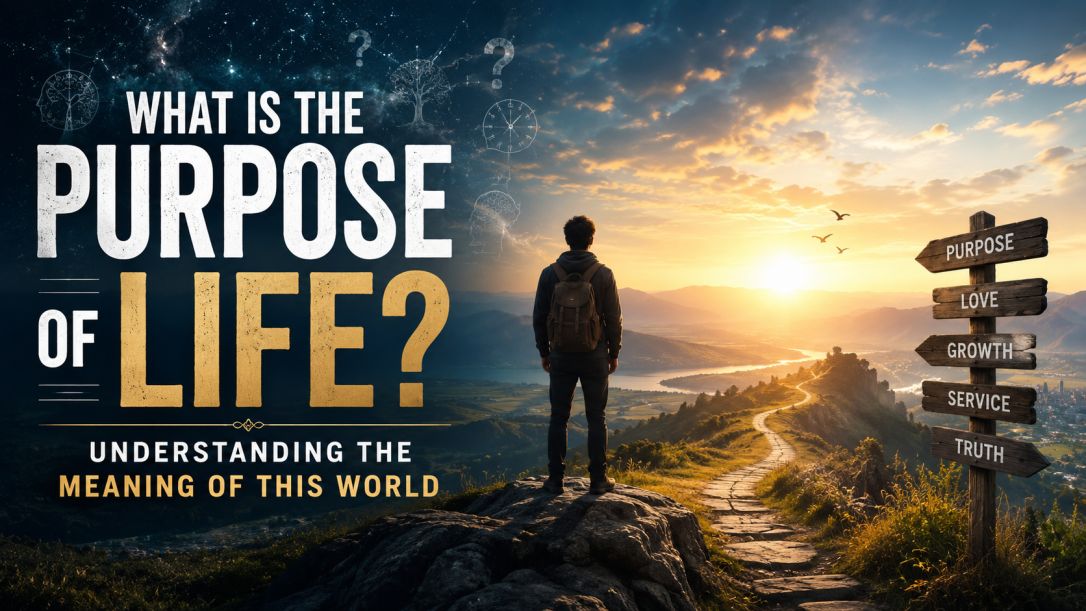
What is the purpose of life? At its core, the purpose of life is to grow, to serve others, and to live with conscious intention oriented toward something greater than yourself. Across faith, philosophy, and psychology, that answer holds. The details differ. The direction doesn’t.
You never just stop mid-sentence and think wait, what am I actually doing here? Not in the room. In life. I had that moment sitting on a rooftop in my mid-twenties, watching the city move like it had somewhere to be, and for the first time I genuinely didn’t know what the point was.
Not in a dark way. More like a confused, wide-awake way. That question of what is the purpose of life never really left after that night. It just got quieter sometimes. Louder than others.
What I’ve noticed is that most people aren’t afraid of the question. They’re afraid of sitting with it long enough to hear something back. Because what comes back might ask something of you.
Why Are We Here And Does the Answer Actually Change How You Live?
We are here to grow, to contribute, and to live with intention not merely to exist, but to matter to something beyond ourselves.
I’ll be straight, why are we here used to sound like something you’d see stitched on a throw pillow. Decorative. Harmless. Easy to ignore.
Then a friend of mine lost his younger brother. Suddenly. No warning. And I watched this man practical, grounded, not remotely philosophical spend weeks asking that exact question like his life depended on the answer. Because in a way, it did. That’s when I understood. This question isn’t decorative. It’s structural. It holds things up.
Philosophers have taken their swings at it for thousands of years. Here is how three major thinkers answered it:
- Aristotle pointed to eudaimonia flourishing, thriving, being fully alive to your own potential
- Sartre said we are thrown into existence without instructions and must build meaning ourselves
- Viktor Frankl argued that meaning is not found but chosen even inside suffering
Neither of them were wrong, exactly. They were just looking at different pieces of the same thing. What strikes me across almost every serious attempt to answer this question, ancient or modern, religious or secular, is that nobody lands on: the point is to be comfortable. Nobody. Not once.
Why Do We Exist? The Question That Gets Harder the More Honest You Are
We exist to find meaning, to develop into the fullest version of ourselves, and to serve others not just to survive, but to contribute something worth leaving behind.
Why do we exist sounds almost too big to take seriously. And yet try not taking it seriously. Try living thirty, forty, fifty years without any real answer to it. See how that goes.
Viktor Frankl watched people survive Nazi concentration camps and watched others, physically stronger, give up and die and noticed the difference wasn’t muscle. It had meaning. He turned that observation into Logotherapy, the healing power of meaning.
That’s not a metaphor. That’s clinical data from one of the worst situations humans have ever created.So why do we exist? Here is what almost every tradition agrees on what it is not:
- Not to accumulate nobody on their deathbed wishes they’d bought more stuff
- Not to be liked approval is exhausting and it runs out
- Not to stay comfortable comfort produces nothing that lasts
And what it is:
- To grow into the fullest version of yourself
- To serve others genuinely, without keeping score
- To leave behind something that outlasts your time here
That last part of pulling others up shows up in almost every tradition I’ve ever read. It’s hard to dismiss as coincidence.
Why Did God Create Human Beings? What Faith Has Said for Centuries
God created human beings to worship Him not only through ritual, but through every conscious, intentional act done in His name.
Why did God create human beings isn’t a question you can answer from a distance. It lands differently depending on what you believe and what you’ve been through.
The Quran says it plainly: “I did not create jinn and humans except to worship Me” (Quran 51:56). Islamic scholars have always taught that ibadah worship wraps around your entire life, not just formal acts of devotion.
Here is how the major faith traditions answer this question:
| Faith Tradition | Why God Created Human Beings |
| Islam | To worship God consciously in every act work, speech, kindness, intention |
| Christianity | To love God and neighbor; humans made imago Dei, in God’s likeness |
| Judaism | To practise tikkun olam to repair and improve the world |
| Buddhism | To end suffering through awareness, compassion, and right action |
What none of these traditions say is that you’re here by accident, or that you don’t matter, or that your presence in this world is without weight. That’s actually a pretty radical thing to sit with.
What Is the Purpose of Life And Why Does Everyone Seem to Have a Different Answer?
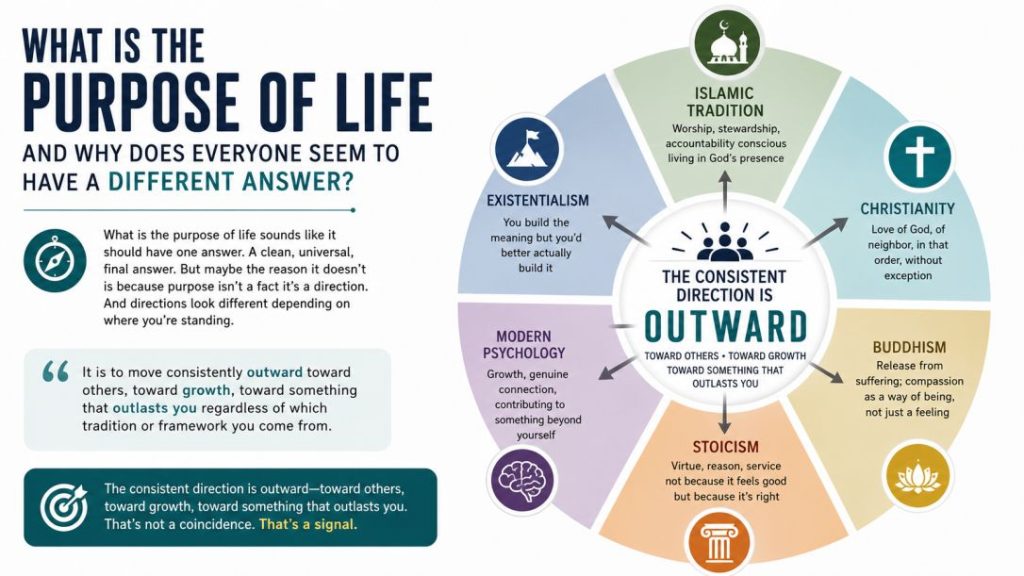
What is the purpose of life? It is to move consistently outward toward others, toward growth, toward something that outlasts you regardless of which tradition or framework you come from.
What is the purpose of life sounds like it should have one answer. A clean, universal, final answer. But maybe the reason it doesn’t is because purpose isn’t a fact it’s a direction. And directions look different depending on where you’re standing.
| Framework | What It Points Toward |
| Islamic tradition | Worship, stewardship, accountability conscious living in God’s presence |
| Christianity | Love of God, of neighbor, in that order, without exception |
| Buddhism | Release from suffering; compassion as a way of being, not just a feeling |
| Stoicism | Virtue, reason, service not because it feels good but because it’s right |
| Modern psychology | Growth, genuine connection, contributing to something beyond yourself |
| Existentialism | You build the meaning but you’d better actually build it |
Read across that table and something jumps out. Nobody’s pointing toward ease. Nobody’s pointing toward status. The consistent direction is outward toward others, toward growth, toward something that outlasts you. That’s not a coincidence. That’s a signal.
How Do You Start Understanding the Purpose of Life Without Waiting Until a Crisis Forces You To?
Understanding the purpose of life begins with small, deliberate choices made before a crisis arrives, not after it forces your hand.Most people don’t ask about understanding the purpose of life until something breaks. A relationship. A career. A loss. Then it becomes urgent. I’d argue: don’t wait.
Here is a practical step-by-step starting point:
- Pay attention to what moves you Notice what makes you genuinely angry, sad, or fired up. Strong emotion is usually pointing at something you care about deeply. That caring is a clue.
- Do something uncomfortable on purpose, not reckless just outside the safe perimeter. The purpose of human life almost never lives inside your comfort zone. Volunteer, create, commit to something that costs you something.
- Get around people whose lives you respect. Not envy respect. Envy wants what they have. Respect wants to understand how they got there. The difference matters.
- Stop postponing meaning It won’t arrive someday. It’s built in the in-between moments you keep skipping past in how you speak to people, in what you choose when nobody is watching.
- Ask yourself the honest question regularly: if this is all I did with my life, would I be okay with that? The answer, whatever it is, is useful.
What Does the Uncertainty of Tomorrow Teach Us About the Purpose of Life?
Uncertainty teaches us that life is temporary and that its purpose must be found in how we use each day, not in what we plan to do someday.
One of the clearest reminders about the purpose of life is that none of us knows what tomorrow holds. We make plans, set goals, and hope for the future, yet the outcome always remains beyond our control. This uncertainty is not meant to create fear, it is meant to encourage humility, gratitude, and trust in God.
When we recognize that life is temporary and unpredictable, we begin to value each day more wisely. Instead of living only for temporary success or material gain, we are encouraged to invest in actions that have lasting value. Kindness, honesty, worship, and helping others become more meaningful when we remember that every moment is a gift.
|
“No person knows what he will earn tomorrow; and no person knows in what land he will die.” (Qur’an 31:34) |
Conclusion
I don’t think what is the purpose of life is a question you answer and retire. I think you answer it, live the answer for a while, outgrow it, and ask it again from a different place.That’s not a failure. That’s what growth actually looks like.
The purpose of life, across every tradition and framework I’ve ever looked at, seems to move in one direction: toward something greater than yourself. Toward genuine love. Toward honest contribution. Toward leaving the specific patch of world you occupied a little better, a little more repaired, than it was when you arrived.
Why are we here? I think we’re here to ask that question seriously enough that it actually changes the way we move through the days. That’s not a small thing. That might be the whole thing.
Why are we here on earth?
Most traditions religious or otherwise land on the same answer: to grow, to serve, and to leave something behind that mattered. We're not here just to pass time; we're here to use it.
Why did God create this world?
In Islamic understanding, this world is a deliberately designed space temporarily, but weighted with consequence where human beings choose how they live and return to God accountable for those choices. It's not a waiting room. It's the test itself.
What is the meaning of this world?
The world doesn't hand you meaning you build it through what you choose, who you show up for, and what you refuse to compromise on. It's impermanent by design, significant by intention.
What is the purpose of our existence on earth?
To know something greater than yourself, to become more than you started as, and to genuinely serve the people around you not one of those in isolation, but all three in honest, messy balance.
Does suffering have anything to do with the purpose of life?
More than most people want to admit suffering strips away what doesn't matter and leaves behind what does. It's rarely the point of life, but it's often where the point finally becomes clear.