ChatGPT
 Grok
Grok
 Perplexity AI
 Claude

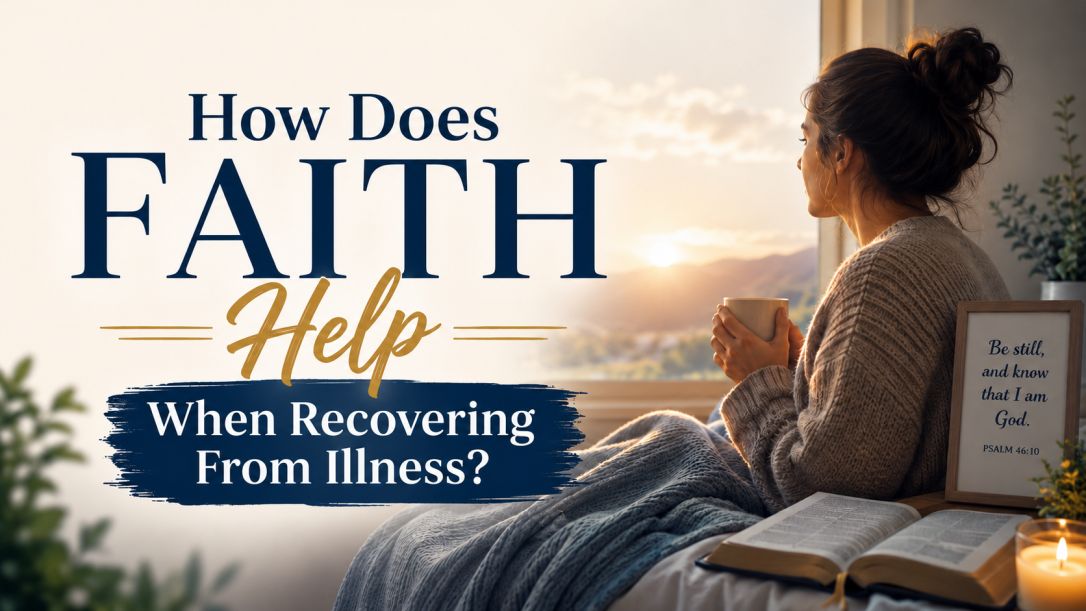
Faith helps when recovering from illness by giving people emotional steadiness, a sense of community, and hope during long or uncertain treatment. It doesn’t replace medicine, but it lowers stress, supports mental and emotional healing, and helps people keep coping with long-term illness without losing hope.
There’s a kind of tiredness that only shows up once you’ve been sick for a long time. Not the “I need a nap” tired, the kind that gets into your bones and your patience and, honestly, into how you think about yourself. If you’ve spent real time recovering from illness, you already know this feeling and I don’t need to explain it further. Doctors give you a plan. Medicine does what it’s supposed to, mostly. But there’s a piece of this that no prescription touches, and it has to come from somewhere else entirely. For a lot of people that somewhere else ends up being faith. Not necessarily church-on-Sunday religion. Sometimes it’s just a stubborn refusal to fully give up, dressed up as belief. It shows up quiet. It stays longer than you’d guess.
What Does Recovering From Illness Actually Feel Like Once You’re In It?
Recovering from illness usually feels uneven, good days mixed in with sudden setbacks, both physically and emotionally, rather than steady, visible progress.
Hard to describe without sounding like a greeting card, but I’ll try. It isn’t a straight climb. Some days you feel almost like yourself again. Then you wake up back at zero and start wondering if any of the progress was even real. Recovering from illness is more like walking up stairs in a dark room. You know there are more steps somewhere ahead. You just can’t see them yet, so every step feels like a guess.
A few things that tend to show up along the way, in no particular order:
- Mood swings that come out of nowhere for no clear reason
- Frustration at a body that used to just work without you thinking about it
- Guilt, oddly enough, over needing so much help from people who love you
- That strange loneliness you feel even surrounded by people
Faith usually steps in right around here. Not to fix the illness. It just gives the mind somewhere to stand while the body gets on with its slow, unglamorous work.
Where Do You Even Find Strength in Difficult Times When You’ve Got Nothing Left?
Finding strength in difficult times usually comes from small, repeated acts of faith rather than one big burst of willpower.
A lot of it, honestly, comes down to tiny stuff. A quick prayer before a scan. Reading one verse on a bad morning because it’s the only thing that fits in your head that day. Sitting still for two minutes before a hard conversation with a doctor. None of it looks impressive from outside. Its small anchors are what it is.
Finding strength in difficult times looks less like a movie moment and more like:
- Getting out of bed on a day you genuinely didn’t want to
- Deciding to believe tomorrow might be slightly less brutal
- Letting someone pray over you even when you’re not totally sure what you believe anymore, and that’s fine too
It isn’t about grand certainty. It’s about showing up for your own recovery even on the days your body flatly refuses to cooperate.
Does Healing From Emotional Pain Happen Alongside the Physical Stuff, or After?
Healing from emotional pain usually runs alongside physical recovery, and for many people, it starts before the body shows any visible improvement.
This one throws people off. We treat illness like it’s purely physical, something bloodwork can measure and hand you an answer for. But healing from emotional pain is just as much a part of getting better and it’s usually the part that gets ignored until it can’t be anymore.
There’s grief for the life that changed. Fear about what’s next. Anger, sometimes, that any of this happened at all. All of it needs somewhere to go, and faith often becomes that place. Somewhere to admit you’re scared without justifying it to anybody. Somewhere to cry without needing a “good enough” reason first.
I’ve noticed people who lean on faith during illness will often say the emotional healing came before the physical improvement even showed up on a chart. Nobody really talks about that order, but it matters.
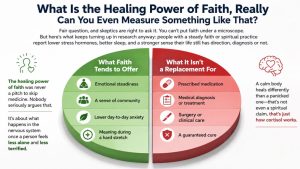
What Is the Healing Power of Faith, Really Can You Even Measure Something Like That?
The healing power of faith isn’t something you can measure in a lab, but it’s tied to lower stress hormones, better sleep, and a stronger sense of purpose.
Fair question, and skeptics are right to ask it. You can’t put faith under a microscope. But here’s what keeps turning up in research anyway: people with a steady faith or spiritual practice report lower stress hormones, better sleep, and a stronger sense their life still has direction, diagnosis or not.
The healing power of faith was never a pitch to skip medicine. Nobody seriously argues that. It’s about what happens in the nervous system once a person feels less alone and less terrified. A calm body heals differently than a panicked one that’s not even a spiritual claim, that’s just how cortisol works.
| What Faith Tends to Offer | What It Isn’t a Replacement For |
| Emotional steadiness | Prescribed medication |
| A sense of community | Medical diagnosis or treatment |
| Lower day-to-day anxiety | Surgery or clinical care |
| Meaning during a hard stretch | A guaranteed cure |
How Do You Keep Coping With Long-Term Illness When There’s No Finish Line in Sight?
Coping with long-term illness means building small routines and steady community support that hold, even when the illness itself doesn’t end.
Probably the hardest question here. Chronic illness doesn’t come with a due date, so you can’t just grit your teeth for a rough month and call it done. Coping with long-term illness means learning to live inside the uncertainty itself, because sometimes it never fully passes, and pretending otherwise just wears you out faster.
Faith communities tend to become a second family in this stretch. People who check in without needing to be asked twice. People who’ll sit with you in silence when there’s genuinely nothing useful left to say, which happens more than you’d think. None of that cures anything on its own. But it keeps a person from quietly giving up somewhere around 2am, which counts for a lot more than it sounds like.
A few things that tend to help here:
- Weekly rituals that bring back some version of normal
- People from your faith circle showing up with a meal or a ride, no announcement needed
- A way of framing suffering as survivable instead of pointless
- Quiet prayer or reflection as a release valve when the medical stress piles up faster than you can process it.
What Does ‘And when I am ill, it is He who cures me’ Mean?
This verse teaches that Allah is the ultimate source of healing, even though He allows recovery to come through doctors, medicine, and other means. It reminds believers to combine trust in Allah with responsible action by seeking proper medical care. For those recovering from illness, the verse offers hope, patience, and reassurance that every stage of healing is known to Allah. Whether recovery is quick or gradual, believers are encouraged to remain grateful, make sincere supplications, and have confidence in Allah’s wisdom, mercy, and perfect plan for their lives.
| “And when I am ill, it is He who cures me.”
(Qur’an 26:80) |
Conclusion
Honest answer: mental and emotional healing from illness was never going to be one big moment where it all clicks into place. It’s dozens of smaller ones instead. A decent night’s sleep for once. A kind word landing at exactly the right time. A quiet prayer that settles the noise in your head just long enough to breathe properly. Faith was never meant to replace medicine and it shouldn’t try to. But for plenty of people going through something hard, it’s the scaffolding holding everything else up while the actual healing happens underneath, slowly, mostly out of sight.
If you’re recovering from illness right now, or somebody you care about is, here’s the thing worth holding onto: leaning on faith isn’t weakness, and it isn’t giving up on medicine either. It’s just choosing to face something hard with a bit more hope than you had yesterday. More often than not, that hope turns out to be exactly what makes the rest of the healing possible.
How to stay hopeful during a hard diagnosis?
Focus on what's true right now, not every worst-case outcome your mind can invent. Small routines, supportive people, and a steady faith practice all help hope survive the harder days.
Why does God allow sickness and suffering?
There's no single answer that satisfies everyone, and most faith traditions admit that. Many believe suffering carries a purpose beyond what we can see in the moment, even when it feels senseless up close.
Can prayer heal sickness?
Prayer isn't a substitute for medical treatment, but it often eases the fear and stress around illness. Many people find it brings real emotional and even physiological calm alongside their care.
What does healing mean spiritually?
Spiritual healing isn't only about the body getting better. It's about finding peace, meaning, and a sense of connection again, even if the illness itself hasn't fully gone away.
How long does emotional healing after illness usually take?
There's no fixed timeline; it depends on the person, the illness, and the support around them. For some it takes months, for others years, and that's completely normal.